Online Shopping Has Matured. E-commerce Stores Must Evolve Too.
The new 2026 E-commerce Survey by GR.EC.A. and ELTRUN reveals a mature online market. Consumers are no longer satisfied with simply being able to shop online. They expect convenience, trust, speed, payment options, and flexibility in delivery and collection. What do all these expectations mean for the design and development of a modern e-commerce store?
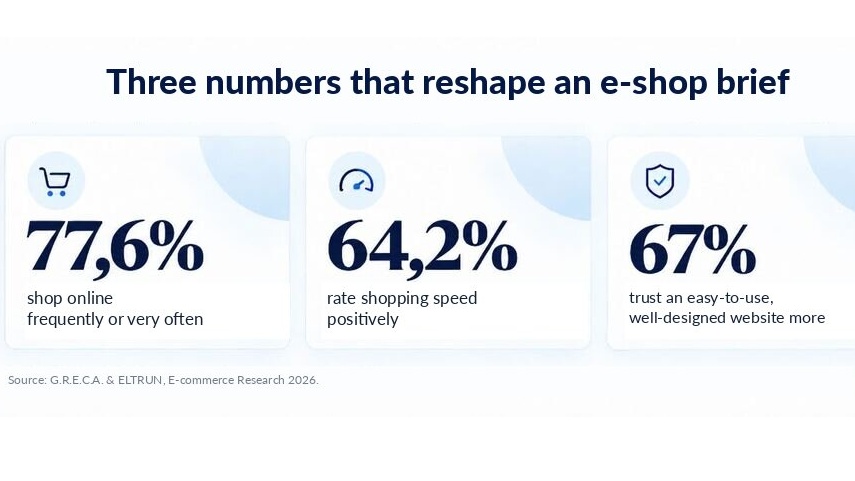
According to the survey, 77.6% of participants say they purchase products or services online “often” or “very often.” Online shopping is no longer an occasional alternative. For a large proportion of online shoppers, it has become an established consumer habit.
This also changes the brief for an e-commerce project. The conversation can no longer begin and end with aesthetics, the platform, or whether the store will “have a checkout.”
A modern e-commerce store must be designed around the entire user journey: from searching for and evaluating a product to payment, delivery or collection, and post-purchase support.
The key question is no longer “Do we have an e-commerce store?” It is “How easy do we make it for customers to choose us, trust us, and complete their purchase?”
1. UX Is Not Just About Aesthetics. It Is a Driver of Trust.
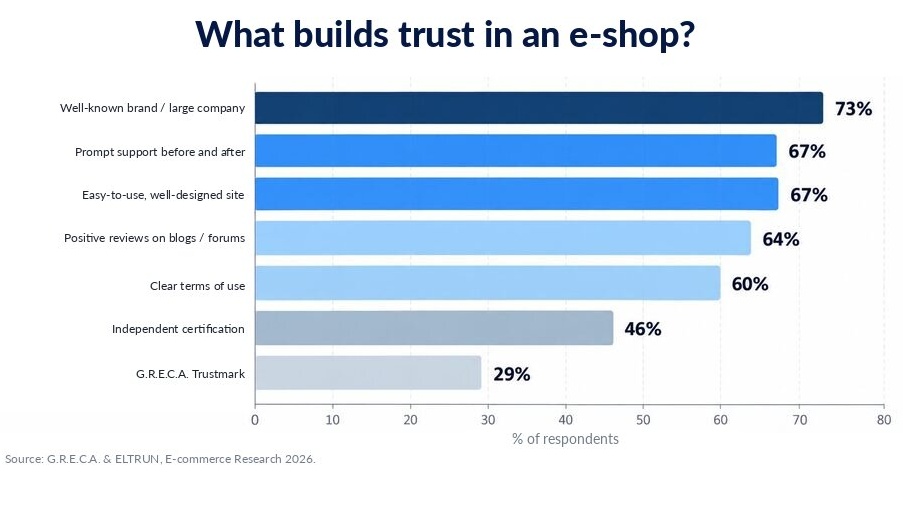
According to the survey, 67% of respondents say that an easy-to-use, well-designed website contributes to their trust in an online store. Prompt support before and after a purchase also scores 67%, positive reviews score 64%, and clear terms and conditions score 60%.
UX, therefore, is not decoration. It is part of the mechanism through which users assess whether an online store is trustworthy. An environment that makes navigation difficult, hides critical information, or creates uncertainty about the next step is not simply less convenient. It introduces friction precisely when users need to make a decision.
In practice, this means an e-commerce store should have:
Clear categorisation, intuitive navigation, and search and filtering tools that help users find the right product quickly.
Product pages that answer key questions about features, availability, delivery, and returns without delay.
Visible trust signals, including company information, transaction terms, customer reviews, and certifications where applicable.
A mobile experience designed as a primary use case, rather than a “smaller version” of the desktop site.
2. Speed Is Not Just About Page Speed. It Is About How Quickly Customers Can Complete a Purchase.
A total of 64.2% of survey participants view “speed in shopping” as a benefit of online shopping. An important distinction is needed here: the survey does not measure loading times, Core Web Vitals, or conversion losses caused by slow pages. Therefore, it would be incorrect to use these findings as evidence that a specific page-load time increases or decreases sales.
What the survey does demonstrate is that consumers expect a fast purchasing process. For design and development, this expectation translates into fewer obstacles: quick product discovery, clear information, fewer unnecessary steps, predictable interface behaviour, and technical performance that does not interrupt the user journey.
The right way to think about “speed” in e-commerce is time to purchase: how easily users move from purchase intent to completing their transaction.
3. Checkout Should Adapt to How Customers Want to Pay.
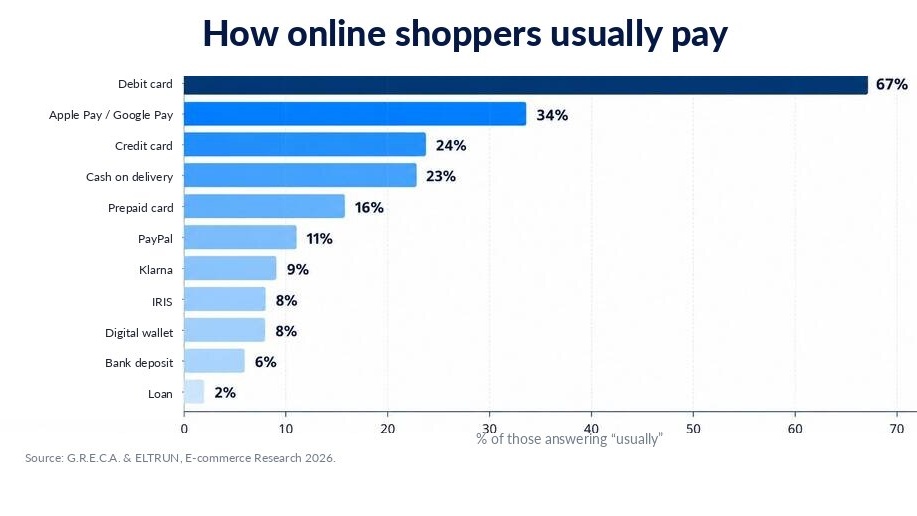
Debit cards remain the dominant payment method, with 67.3% of respondents saying they usually use them. Apple Pay and Google Pay account for 34.4%, highlighting the growing importance of mobile-first payments.
The survey does not measure checkout abandonment or compare guest checkout, the number of form fields, or one-page checkout experiences. However, it does point to a clear development requirement: users expect payment options, and checkout must present them without becoming more complicated.
Core payment methods should be clearly displayed and presented without ambiguity.
Mobile checkout must be designed for real-world use on mobile devices.
Shipping costs, delivery times, and delivery methods must be clearly communicated before the final order confirmation.
Payment integrations must work reliably and provide clear feedback when a transaction succeeds, fails, or remains pending.
It is also worth noting that 23% of respondents say shipping costs are “usually” high relative to the value of the product. Revealing shipping costs late in the process does not solve the problem. It simply shifts the frustration closer to the point of purchase completion.
4. The Shopping Experience Does Not End at “Pay.”
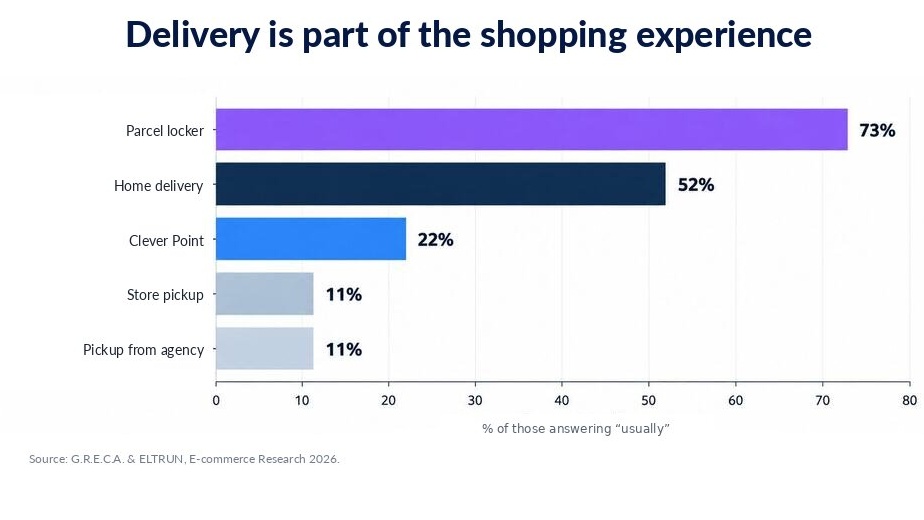
Lockers are now the most commonly used delivery or collection option among survey participants: 73.1% say they usually use them, compared with 52.5% who usually opt for home delivery. (pp. 20 and 28) This shift shows that delivery flexibility has become an integral part of the e-commerce experience.
As a result, part of the UX responsibility extends beyond the front end to integrations and operational design. An e-commerce store must be able to display available delivery and collection options accurately, manage service areas and collection points, and maintain a seamless experience after checkout through order confirmations, tracking, notifications, and a clear returns process.
5. The E-commerce Store Is a Central Part of the Customer Journey — But Not the Only One.
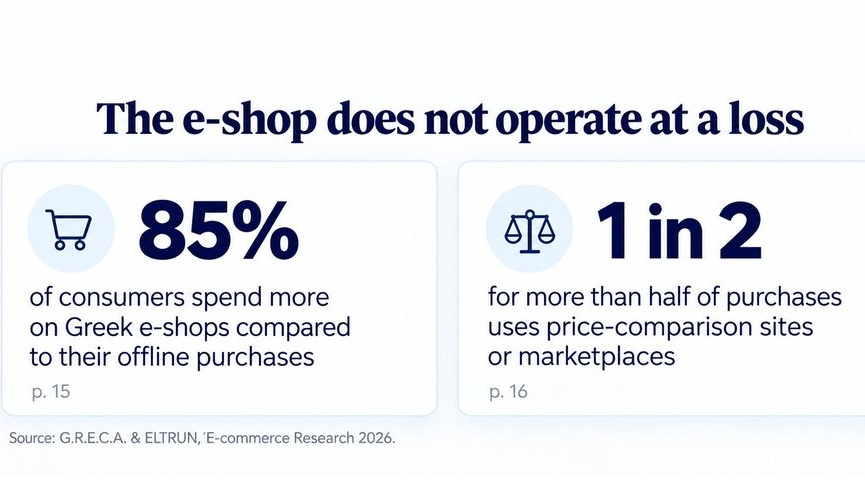
Some 85% of shoppers make more than half of their online purchases from Greek e-commerce stores. At the same time, one in two uses price-comparison websites or marketplaces for more than half of their purchases.
Before making an online purchase, consumers primarily seek information on websites featuring user reviews, company websites, and price-comparison platforms.
This means an e-commerce store should be treated as part of a wider ecosystem, rather than as a standalone digital storefront.
Consistent product information across the website, product feeds, and marketplaces.
An SEO architecture that makes categories and products easy to discover.
Accurate structured product data and the appropriate technical infrastructure.
Review management and trust signals as integral parts of the customer journey.
Analytics that reveal where users come from and at which point purchases are lost.
What Should an E-commerce Project Brief Include in 2026?
If we translate the survey findings into practical requirements, the following questions should be answered before development begins.
1. Information Architecture: How will users find the right product, and what filters, categories, and search logic will they need?
2. Product Experience: What information do customers need to compare products and make decisions with confidence?
3. Trust: Where and how will reviews, terms and conditions, returns policies, company details, and certifications be presented?
4. Checkout: Which steps are genuinely necessary, and which payment methods must be supported?
5. Delivery & Fulfilment: How will lockers, couriers, collection points, delivery times, and shipping costs be integrated?;
6. SEO & Discoverability: How will categories and products remain visible in search results and across other channels?
7. Measurement: Which events and KPIs will help us identify friction points and understand where conversions are being lost?
An E-commerce Store Is Not a Digital Catalogue. It Is a Commercial System.
The key message of the 2026 E-commerce Survey is not simply that online shopping has become firmly established in consumers’ everyday lives. It is that online shoppers have clear expectations about how they want to buy: easily, quickly, transparently, with options and consistency.
That is why building a modern e-commerce store cannot be treated as a “design + development” project. It requires a combination of strategy, UX, technology, SEO, integrations, and measurement. The goal is not simply to make the website work. It is to make it work for the way customers shop today.
Planning a New E-commerce Store or a Redesign?
We are here to help you make the right decisions before development begins — from site structure and UX to checkout, payments, integrations, and measurement.
Let’s design an e-commerce store built around how customers actually search, choose, and buy.
The 2026 E-commerce Survey was conducted by the Greek E-Commerce Association (GR.EC.A.) and the ELTRUN E-Business Research Center at the Athens University of Economics and Business, using a sample of 600 Greek consumers who shop online.
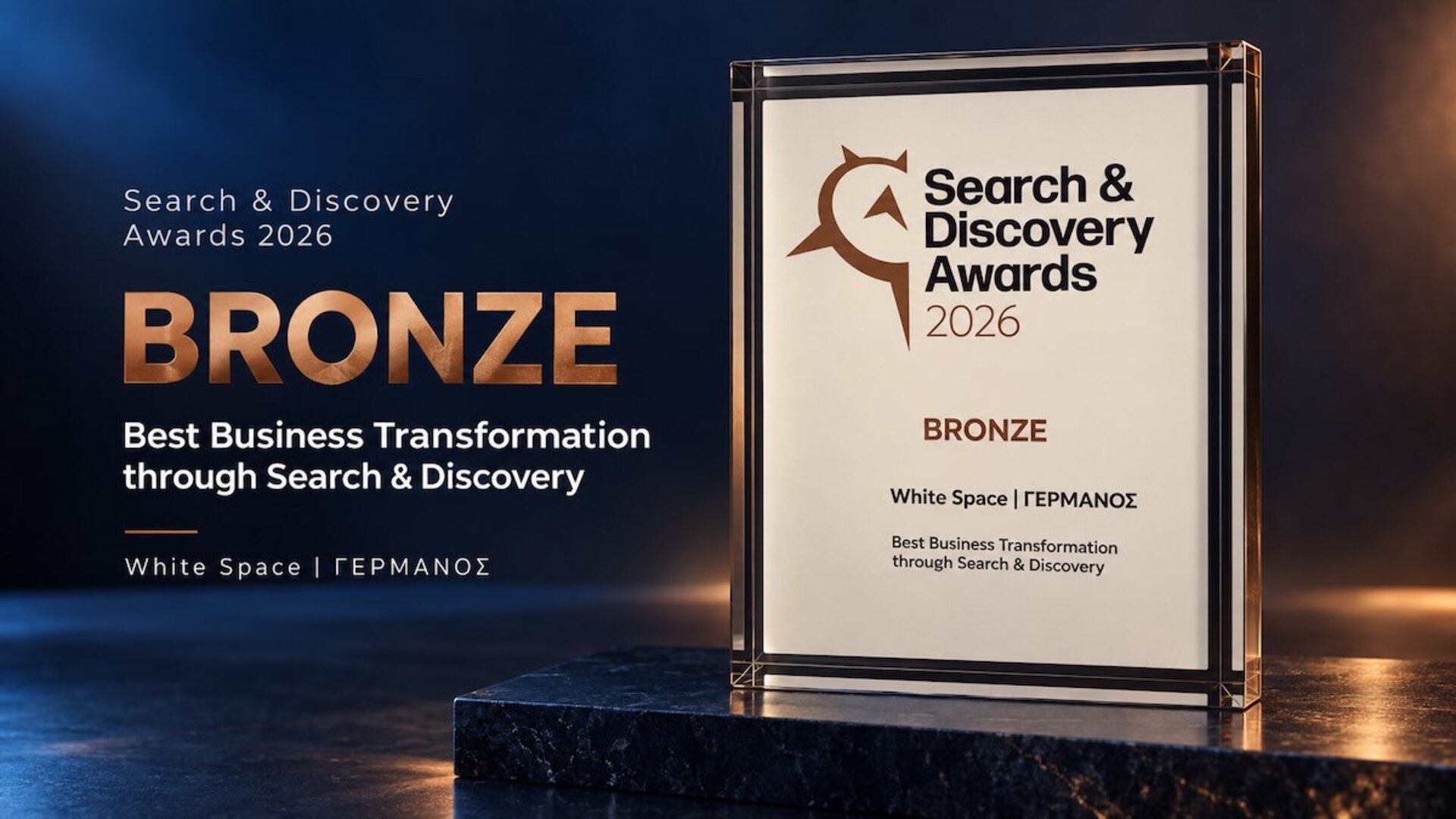
We are truly happy and proud that White Space received a Bronze Award at the Search & Discovery Awards 2026 for the SEO strategy we designed and implemented for GERMANOS.
This recognition is especially meaningful to us because it acknowledges work built on strategy, data, consistency and continuous optimisation — all core elements of the way we approach SEO.
The Search & Discovery Awards, organised for the first time by BOUSSIAS Events, were created to recognise strategies, projects and teams that strengthen brand visibility across the places where people search for information and discover new choices, connecting visibility with meaningful business growth.
Our strategy for GERMANOS was designed to strengthen the brand’s organic presence in a way that directly supports its broader business objectives.
Through a data-driven SEO framework combining SEO architecture, on-page optimisation, supportive content, SEO PR and technical SEO, we expanded the brand’s organic presence across products, categories and search intents with real commercial value.
Entries were evaluated by a panel of experienced professionals from Greece and abroad, with Aleyda Solis serving as Honorary Jury President — one of the most internationally recognised figures in SEO.
For us, this award is more than a distinction. It is a validation of the way we approach SEO: not simply as rankings and visibility, but as an integral part of a brand’s broader growth strategy.
And, of course, none of this happens in isolation.
A big thank you to the GERMANOS team for their trust and collaboration, and to the White Space team for the strategic thinking, expertise, consistency and attention to detail behind the work.
We are proud of this recognition — and even more proud of the work behind it.
For a construction company or a real estate business, the website is often one of the first points of contact with a potential client, buyer or investor.
And while aesthetics clearly matter in an industry where image plays a decisive role, a visually impressive website is not enough on its own.
It needs to clearly explain who the company is, what differentiates its projects or services, what value it provides and why someone should choose it. At the same time, it needs to present projects effectively, build trust and guide visitors towards the next step.
Because in real estate, a website is not simply a digital showcase. It is a tool for positioning, branding, marketing and sales.
That is where the real difference lies between a website that simply looks good and one that actively contributes to business growth.
1. Clearly communicate the positioning of the company or project
Real estate websites often place strong emphasis on visual impact: impressive renders, architectural photography, videos and animations designed to showcase the project.
But a strong visual presence is not enough. Before design comes a more fundamental question:
Why should someone choose this company or this particular project?
Contemporary architecture, a strong location or high construction quality do not, on their own, constitute positioning — especially when similar promises are being made by almost every competitor.
The website should clearly communicate:
the company’s philosophy and identity,
the audience it is addressing,
what differentiates its approach or projects,
the value it offers to buyers or investors,
and the position it wants to occupy in the market.
If these elements are not clear, even an exceptionally designed website may ultimately present a company that looks very similar to many others.
2. Turn features into real value
In real estate, simply listing features is not enough.
Visitors do not only want to know how many square metres an apartment has, what materials are being used or how far a development is from the city centre.
They want to understand what all of this means for them.
A strong energy rating may mean lower running costs.
The location may mean a better everyday lifestyle or stronger investment potential.
The architecture may translate into more natural light or more efficient use of space.
Shared amenities may significantly influence the way residents live.
The right website therefore does more than provide information.
It turns information into benefits and benefits into perceived value.
3. Guide visitors through a clear journeyομή
Not everyone visits a real estate website with the same intent.
One visitor may already know the project and be looking for a specific apartment. Another may only be at the beginning of their research. An investor may be more interested in the location and its future prospects, while a homebuyer may place greater importance on quality of life.
The website needs to support these different needs and naturally guide users from first contact towards a decision:
This requires the right information architecture, clear navigation, proper content hierarchy and calls to action that appear at the moments when they are genuinely relevant.
4. Present projects in a way that supports decision-making
Visuals play a critical role in real estate, particularly when a project is still under construction.
But their purpose should not simply be to impress.
Renders, photography, videos, floor plans, maps, availability information and interactive elements should help visitors understand the property more clearly.
How are the spaces organised?
What is the relationship between indoor and outdoor areas?
Where is the project located in relation to important points in the surrounding area?
What types of residences are available?
What differentiates one option from another?
Good presentation does more than add aesthetic value.
It reduces uncertainty for the prospective buyer.
5. Build trust
Buying or investing in property is a high-value decision. Visitors are therefore not only evaluating the project.
They are also evaluating who is behind it.
The company’s experience, previous projects, partners, architects, contractors, certifications, project progress and factual information about the company’s track record can all act as important credibility signals.
A strong portfolio, for example, should not function simply as a gallery.
It should demonstrate experience, consistency and the ability to deliver.
In real estate, trust is not an additional element of the website.
It is part of the sales process.
6. Turn interest into qualified leads
The website should not end with presentation.
There needs to be a clear next step.
Depending on the company or project, visitors may want to:
request more information,
download a brochure,
express interest in a specific property,
request available prices or floor plans,
schedule a meeting,
contact the sales team.
The objective, however, is not simply to have forms on the website.
The objective is to create the right conversion points at the right stages of the user journey.
A simple “Contact Us” button at the bottom of a page does not, by itself, constitute a sales funnel.
7. Support advertising campaigns
Google Ads, Meta Ads, remarketing and other paid activities can bring significant traffic to a real estate website.
But if the experience after the click is not right, part of that investment is wasted.
The landing page should continue the campaign message seamlessly and take users directly to the content they expect to find.
If an ad promotes a specific development or property type, users should not land on a generic corporate homepage and be expected to search for the information themselves.
The website and performance marketing need to work as one integrated system.
8. Be designed for organic search as well
A real estate website should not depend exclusively on paid traffic for visibility.
Users search for information about locations, properties, new developments, homes for sale, investment opportunities, developers and specific property types.
For a website to appear in these searches, it needs:
a strong SEO structure,
clear headings and URLs,
content aligned with search intent,
effective internal linking,
landing pages for important topics,
and valuable, useful content around the market and the projects.
At the same time, as search behaviour evolves, content needs to be structured so that it can be understood not only by traditional search engines but also by AI-powered search environments.
This is why SEO should now be considered together with GEO and AEO, rather than as an isolated technical activity.
9. Perform flawlessly on mobile
One of the most common issues with real estate websites is that the desire to create a highly impressive visual experience often results in excessively heavy websites.
Large videos, high-resolution renders, sliders and animations can significantly affect speed and usability — particularly on mobile devices.
This creates a clear contradiction:
A company may be communicating quality, contemporary design and attention to detail while its website takes several seconds to load or is difficult to use on a mobile device.
Speed, technical performance and mobile UX are not in opposition to aesthetics.
They are part of the overall quality of the experience.
10. Measure what actually works
Without data, a website remains, to a large extent, based on assumptions.
How many users visit a specific project?
Which property types attract the most interest?
Which channels generate the leads?
How many users begin a form and how many complete it?
Which campaigns generate higher-quality enquiries?
A website should be designed from the outset with proper analytics and conversion tracking in place.
And where there is a structured sales process, connecting digital leads with the CRM can provide even more meaningful insights.
Because the real question is not simply how many leads were generated.
It is which of those leads developed into genuine commercial opportunities.
A strong real estate website is part of a larger system
A website does not operate in isolation.
It is connected to brand positioning, corporate identity, projects, content, advertising, SEO, lead generation and ultimately the sales process.
That is why its design should not begin with the question:
“How do we want it to look?”
But with more meaningful questions:
Who are we speaking to? What do we want them to understand? What needs to convince them? And what action do we want them to take next?
Aesthetics remain important — especially in real estate.
But they are only one part of the equation.
An effective website is one that brings together strategy, positioning, branding, UX, technology, search and lead generation into one cohesive experience.
Want your real estate marketing to work as one integrated system?
At White Space, we approach real estate marketing holistically: from strategy and positioning to branding, website development, lead generation, performance marketing and SEO.
The objective is not simply to create an attractive digital presence, but to build a system that actively supports the commercial growth of the company or project.
Brand Strategy and Marketing Strategy are two fundamental pillars of business growth. Both start with the market and the customer, and both influence how a brand builds its position, communicates its value and develops relationships with its audience.
A company may invest heavily in marketing and still struggle to explain why customers should choose it over its competitors. At the same time, a business may have built a strong brand but lack a clear strategy for turning that strength into greater awareness, demand and sales.
They are two different strategies with distinct roles, but the effectiveness of one directly influences the other. Brand Strategy defines what the brand stands for, the value it offers, how it differentiates itself and the position it wants to occupy in the market. Marketing Strategy determines how that position will be translated into specific choices and actions that bring the brand to the right audience and generate demand, customers and growth.
The question, therefore, is not which one to choose. It is understanding what each strategy actually does, which should come first and how they can work together as one integrated system for growth.
What Is Brand Strategy?
Brand Strategy is the strategic foundation on which a brand is built.
It is not simply about the logo, colours or overall visual identity. Those are expressions of the brand. Strategy comes first and determines what that identity should actually communicate.
A comprehensive Brand Strategy should answer questions such as:
Who is the brand trying to reach?
What needs or expectations does it address?
What value does it provide?
How does it differ from the alternatives available in the market?
What position does it want to occupy?
What is its personality and character?
What promise does it make to its customers?
What does it want to be known for?
At the heart of Brand Strategy are elements such as Brand Positioning, Value Proposition, Target Audience, Brand Personality, Tone of Voice and the brand’s distinctive assets and characteristics.
When these elements are clearly defined, the business gains a consistent strategic reference point for every decision that follows — from its website and communications to campaigns and the sales process.
What Is Marketing Strategy?
Marketing Strategy begins with a different, but closely connected, question:
How do we bring the business and its value proposition to the market effectively?
An important distinction is needed here.
Marketing Strategy does not simply mean Google Ads, social media, SEO, email marketing or content.
These are tools and channels. Strategy determines why, how, where and for what purpose they should be used.
A Marketing Strategy considers, among other things:
which markets and audiences should be prioritised,
which products or services the business wants to grow,
which messages are most likely to resonate with the audience,
which channels are most appropriate,
how the customer journey should be structured,
how awareness and demand will be generated,
how leads and sales will be acquired,
how the marketing budget should be allocated,
which KPIs should be monitored,
and how the effectiveness of marketing activity will be measured.
Put simply:
Brand Strategy defines the position a brand wants to occupy in the market. Marketing Strategy defines how the brand will compete for and build that position.
Brand Strategy vs Marketing Strategy: The Key Differences
Although the two strategies are closely connected, they do not serve the same purpose.
Brand Strategy
Marketing Strategy
Defines what the brand is and what it stands for
Defines how the brand will grow in the market
Establishes positioning and differentiation
Defines audiences, channels and actions
Builds perception and long-term brand value
Generates awareness, demand and commercial results
Creates strategic consistency
Turns strategy into action
Defines the core value proposition and messaging
Determines how, where and when those messages will be used
Has a more long-term perspective
Adapts more frequently to market conditions and performance data
The fundamental difference is that Brand Strategy acts as a strategic compass, while Marketing Strategy determines how the business will move in that direction.
What Happens When You Have a Marketing Strategy Without a Clear Brand Strategy?
A company may have a strong social media presence, invest in Google Ads, publish content consistently and allocate a significant budget to advertising.
But if it has not clearly defined what makes it different, what value it provides and why customers should choose it, its marketing will struggle to create meaningful differentiation.
That is when familiar messages start to appear:
“High quality.”
“Complete solutions.”
“Experience and reliability.”
“We are by your side.”
These claims may all be true. But they could also belong to almost any competitor in the same market.
The result?
The company may increase its visibility without necessarily becoming more recognisable, distinctive or desirable.
More marketing does not automatically fix weak positioning. In some cases, it simply puts a generic message in front of more people.
And What Happens When You Have a Strong Brand Strategy Without a Marketing Strategy?
The opposite can also happen.
A business may have clear positioning, a strong identity and a compelling value proposition. But without a strategy for reaching its audience, the brand cannot fully capitalise on that potential.
It needs a system that takes the strategy into the market.
SEO helps the brand be present when potential customers are actively searching for solutions.
Performance Marketing creates targeted visibility and demand.
Content Marketing gives the brand the space to demonstrate its knowledge, expertise and perspective.
Social Media strengthens visibility and maintains an ongoing relationship with the audience.
The website turns the strategic positioning of the brand into a tangible customer experience.
And the sales process should continue delivering the same promise the brand has established through its communication.
A strong brand, therefore, still needs marketing to build the necessary reach and commercial momentum.
How Do Brand Strategy and Marketing Strategy Work Together?
Their relationship is not linear, nor does it end when a branding project is completed.
In practice, they operate as part of a continuous system.
1. Start With the Market and the Customer
Every serious strategy begins with understanding.
Understanding the market.
The competitive landscape.
The customers.
Their needs.
The trends shaping their behaviour.
And, of course, the actual commercial objectives of the business.
Without this information, both Brand Strategy and Marketing Strategy risk being built on assumptions rather than genuine market insight.
2. Define the Brand Positioning
The next step is to answer one critical question:
What position do we want the brand to occupy in the customer’s mind?
Brand Positioning is not a tagline.
It is a strategic decision about how the market should perceive the brand compared with the other choices available to customers.
This is where the value proposition, differentiation, core messaging and overall strategic direction of the brand are established.
3. Turn Positioning Into Marketing Strategy
Once we know what we want the brand to stand for, we can determine how to communicate that position and build demand around it.
Which audience should we reach first?
Which message matters most to them?
Which channels are they using?
Where are they in the buying journey?
What action do we want them to take?
Marketing Strategy turns positioning into a clear go-to-market plan.
4. Create Consistency Across Every Touchpoint
Customers do not experience a brand only through a campaign or a logo.
They encounter it on Google.
On the website.
On LinkedIn.
In a presentation.
In an email.
During a sales meeting.
And in the service they receive after the sale.
Every one of these touchpoints should reinforce the same strategic perception of the brand.
That does not mean everything has to look or sound exactly the same. It means everything should lead towards the same clear position.
5. Measure, Learn and Adapt
The relationship between Brand Strategy and Marketing Strategy also works in the opposite direction.
Marketing generates data.
Which messages receive the strongest response?
Which audiences show the greatest interest?
What are people searching for?
Why do new customers choose the business?
Where are conversions being lost?
Which services generate the strongest demand?
This information should not remain buried in campaign reports.
It should feed back into strategy and help the business refine and improve its decisions.
A Simple Example
Imagine two B2B companies offering a similar service.
The first communicates:
“We provide comprehensive and reliable solutions tailored to your needs.”
The second has chosen to position itself as the specialist partner for large organisations that need to reduce the time and complexity involved in a specific business process.
The second proposition is already far more strategically defined.
That positioning will influence:
the website content,
the case studies the company chooses to showcase,
the keywords targeted through SEO,
its Google Ads messaging,
its LinkedIn content,
its corporate presentations,
the structure of its sales arguments,
and even the way its pricing is presented.
Marketing Strategy no longer needs to reinvent the message every time.
There is a clear Brand Strategy providing direction.
Which Strategy Should Come First?
The easy answer would be: Brand Strategy.
The more accurate answer begins one step earlier.
Before developing either a branding or marketing strategy, a company first needs a solid understanding of the business, the market, the competitive landscape and the customer.
Brand Strategy is built on that understanding.
Marketing Strategy can then be developed on top of the Brand Strategy, ensuring that marketing does not become a collection of isolated activities but instead supports a clear business direction.
“Let’s launch some campaigns and figure out what we want to say along the way.”
Because in that case, marketing is being asked to solve a problem that actually exists one level earlier — at the strategic level.
Brand Strategy and Marketing Strategy Work Better Together
The real question, therefore, is not whether a business needs Brand Strategy or Marketing Strategy.
It needs both.
Brand Strategy provides direction, positioning, differentiation and consistency.
Marketing Strategy turns that direction into market presence, demand, data and growth.
Without a clear Brand Strategy, marketing risks becoming a collection of disconnected activities that may produce short-term results without building a stronger brand over time.
Without a Marketing Strategy, even a brilliantly conceived brand may never achieve the reach and commercial momentum it has the potential to create.
The greatest value is generated when business strategy, brand and marketing operate as one integrated system.
From Strategy to Growth
At White Space, we see branding and marketing as interconnected parts of the same business strategy.
We start by understanding the business, the market and the competitive landscape. We then define a clear positioning and translate that strategy consistently across every relevant touchpoint — from brand identity and website development to SEO, content and performance marketing.
Because before deciding where and how a brand should appear, we first need to define what we want it to mean in the market and why customers should choose it.
Contact us to develop a Brand & Marketing Strategy that connects your brand identity with real business objectives.
The real estate market remains highly active. According to data from the Bank of Greece, apartment prices increased by 5.7% year-on-year in the first quarter of 2026, continuing the upward trend of recent years.
An active market, however, also means greater competition.
New residential developments, tourism properties, investment projects and mixed-use developments are competing for the attention of the same buyer and investor audiences. In this environment, a good property is not enough on its own.
It needs to be presented the right way.
Real Estate Marketing is not simply about advertising a property on Google, social media or property portals. It is the process through which a real estate project establishes a clear market position, a strong identity, an effective digital presence and an organised system for attracting prospective buyers or investors.
And that process begins long before the first campaign goes live.
1. Understanding the Project Before Marketing
Every real estate project is different.
Its location, architecture, build quality, amenities, price point, target audience, intended use and investment profile all create a different commercial reality.
That is why the first step cannot be:
“Which channels should we advertise on?”
The right question is:
“What exactly do we have to offer, to whom, and why should they choose it?”
Before any communication begins, we need to understand:
the project itself and its competitive advantages,
the area and its market dynamics,
competing developments,
the different buyer or investor profiles,
the real decision-making criteria,
the commercial objectives of the project.
Without this foundation, even a well-designed campaign may simply generate more visibility for an unclear message.Χωρίς αυτή τη βάση, ακόμη και μια καλοσχεδιασμένη καμπάνια μπορεί απλώς να δημιουργήσει περισσότερη προβολή ενός ασαφούς μηνύματος.
2. Positioning: Why Should Someone Choose This Property?
Positioning is perhaps the most critical – and often overlooked – part of real estate marketing.
Two properties may be in the same area, offer a similar amount of space and have comparable features, yet appeal to completely different audiences.
One may be positioned as an investment opportunity.
Another as a contemporary way of urban living.
A third may be defined by its architecture, privacy, location or a specific lifestyle.
Marketing needs to turn the property’s technical features into a clear value proposition.
Not simply:
“contemporary apartments with exceptional build quality.”
But a clear answer to:
Who was this project created for, and what makes it different from the other options?
The brand, website, content and campaigns should then flow from that answer.
3. Property Branding: Turning the Property into a Brand
In a professionally developed real estate project, we are not selling square metres alone.
We are shaping perception.
Property Branding gives the project a recognisable identity and helps the audience perceive it as a complete proposition rather than just another property listing.
Depending on the size and nature of the project, this may include:
naming,
logo and visual identity,
colour and typographic direction,
messaging,
tone of voice,
sales presentation,
brochures and other sales collateral,
overall art direction.
Branding becomes even more important when a property is still under development and prospective buyers are being asked to understand the value of a project before they can see it completed.
In this case, the brand, renders, storytelling and overall presentation act as a bridge between what is being built and what the buyer understands they are going to acquire.
Today, a prospect’s first meaningful interaction with a project is very likely to happen online.
They may see an ad, search for the project on Google, visit the website or look for more information about the area and the developer.
The website, therefore, should not function merely as a digital brochure.
It needs to answer the prospect’s key questions quickly:
What is it? Where is it located? Why is it worth considering? What options are available? Who is behind the project? And how can I learn more?
An effective real estate website or microsite needs:
clear information architecture,
a strong visual presentation,
easy navigation on mobile devices,
fast loading times,
a clear presentation of property types and features,
location information and points of interest,
floor plans, renders, photography or video where needed,
prominent calls to action,
well-designed enquiry forms.
Design matters. But without UX, the right information and a clear conversion path, it remains just design.
5. Content That Creates Desire and Builds Trust
A property is a high-involvement purchase.
The decision is not made because of an impressive render or an Instagram post.
Prospective buyers want to understand the project, the area, the developer, the features, its potential value and – depending on the case – the investment outlook.
That is why content needs to work on multiple levels.
Strong imagery, video, architectural renders and social content are certainly important.
But meaningful information is equally important.
Articles about the area, presentations of the concept, the architectural approach, amenities, construction progress, FAQs and investment information can create a far stronger content ecosystem around the project.
SEO in Real Estate Marketing is not only about ranking for the project’s name.
A prospective buyer may be searching for:
new-build apartments in a specific area,
investment properties,
homes of a specific type,
information about a particular area,
real estate developments in Athens or another destination,
properties for sale in Greece.
These searches happen at different stages of the buying journey.
With the right SEO strategy, a project can gain visibility not only when someone already knows its name, but also while they are still researching and comparing options.
At the same time, well-organised information, clearly defined entities, structured data and meaningful content improve the project’s ability to be understood by modern AI search and answer engines.
Search visibility is no longer limited to traditional Google results.
It is about how easily a project can be found, understood and evaluated online.
Google Ads, Meta Ads and other paid media can significantly accelerate a project’s visibility.
Provided they are used properly.
The logic of:
“we run ads and wait for leads”
is not enough.
Campaigns need to connect with the customer journey.
Someone seeing the project for the first time needs a different message from someone who has already visited the website, reviewed the floor plans or returned several times.
The objective is not to put the project in front of as many people as possible.
It is to put it in front of the right people.
8. We Don’t Just Want More Leads. We Want Better Leads.
This is where one of the most important mistakes in Real Estate Marketing appears.
The success of a campaign cannot be judged only by the number of forms submitted.
A project may generate dozens of leads that lack genuine interest, purchasing power or real intent to buy.
The right question is:
How many of those leads have real commercial value?
That is why marketing and sales need to be connected.
We track not only:
impressions,
clicks,
website traffic,
cost per lead,
but also:
lead quality,
qualified enquiries,
appointments,
site visits,
the source of the highest-quality leads,
conversion into a genuine commercial opportunity.
In real estate, the cheapest lead is not necessarily the best lead.
Real Estate Marketing Should Work as a System
Positioning without the right presentation is not enough.
A strong brand without traffic is not enough.
Traffic without the right website is not enough.
Leads without qualification and follow-up are not enough either.
Truly effective Real Estate Marketing connects all these elements in one integrated process:
Project Understanding → Audience Strategy → Positioning → Property Branding → Digital Experience → Content → SEO → Performance Marketing → Lead Generation → Measurement & Optimization.
That is the real difference between simply promoting a property and strategically marketing a real estate project.
A Good Project Deserves Marketing to Match
The quality of the property is, of course, the foundation.
But the market can only evaluate what it can see, understand and compare.
That is why a real estate project needs more than beautiful imagery and a media budget.
It needs a clear market position, a consistent identity, a strong digital experience and marketing built around specific commercial objectives.
At White Space, we approach Real Estate Marketing as an integrated process that connects strategy, branding, digital experience and performance.
Because the objective is not simply for more people to see a project.
It is for the right people to understand why it is worth choosing.
As a business evolves, its goals, services, audience and market position naturally evolve with it. The real question is whether its brand is evolving at the same pace.
When we hear the word rebranding, we often think of a new logo, different colours or a more contemporary visual identity. In reality, meaningful rebranding starts much deeper: at the point where the existing brand no longer accurately reflects what the business has become, the value it delivers or the position it wants to occupy in the market.
A company may have grown, started addressing new audiences, changed its services, strategy or market level, while its brand still reflects an earlier version of the business.
When that happens, the issue is not simply aesthetic. It becomes a matter of positioning, perception and business strategy.
And that is exactly when rebranding starts becoming a genuine business need.
What Does Rebranding Really Mean?
Rebranding is the process of redefining how a business positions itself, presents itself and is perceived in the market.
It may involve changes to the brand positioning, value proposition, key messages, name, logo, visual identity, tone of voice and, ultimately, the overall experience the brand creates.
That is why meaningful rebranding should never begin with the question:
“How should we change the logo?”
The right question is:
“Does our current brand still represent who we are, what we offer and the position we want to hold in the market?”
If the answer is no, then there is a strong reason to seriously consider rebranding.
When Does a Business Really Need Rebranding?
There are specific business circumstances in which an existing brand starts functioning more as a limitation than an advantage.
The Business Has Changed Significantly
A company may have started with a single service and now offer a much broader portfolio. Its business model may have changed, or it may now operate across entirely different markets.
When the brand continues to describe the company as it existed years ago, a clear gap emerges between the reality of the business and the way it is perceived.
The Positioning Is No Longer Clear
If customers struggle to understand why they should choose one company over a competitor, the problem may go deeper than communication.
Rebranding can help redefine the brand’s position, differentiation and value, allowing the market to understand more clearly what the company stands for and why it is different.
The Audience or Market Has Changed
A company may now be targeting larger organisations, different age groups, new industries or international markets.
A brand that worked effectively for one audience will not necessarily remain equally relevant to the next.
The Brand Image Undervalues the Company’s Real Value
This often happens when a business evolves much faster than its corporate image.
Its services, expertise, client portfolio and overall quality may have moved to a significantly higher level, while the way the company presents itself remains outdated or positions it below where it actually belongs.
In this situation, the brand is no longer strengthening the value of the business.
It is limiting it.
There Has Been a Merger, Acquisition or Major Organisational Change
A merger or acquisition almost always raises questions around identity.
Which brand should remain? Which elements are worth protecting? How should the new corporate reality be expressed? How can confusion among customers and the wider market be avoided?
In these cases, rebranding can become the bridge between the company’s previous identity and what it is becoming next.
The Existing Brand Is Limiting Growth
A name that is too closely associated with a single service, location or product may work perfectly well in the early stages of a business, but become restrictive when the company wants to expand.
In this case, rebranding is not necessary because the old brand is “bad”.
It is necessary because the brand can no longer support the company’s future direction.
There is one common factor across all these situations:
The business has changed more than its brand has.
When Is Rebranding Not Necessary?
This is where one of the most common mistakes happens.
The fact that a logo looks dated — or that the management team has simply grown tired of it — is not, on its own, a reason to rebrand.
Neither is a temporary decline in sales, a new design trend or the fact that a competitor recently changed its identity.
Rebranding should not be used as an aesthetic exercise or as an attempt to artificially create the impression that “something new is happening”.
If the positioning remains strong, the brand is recognisable and it still accurately represents the business, a complete rebrand is probably unnecessary.
What may be needed instead is a brand refresh.
Rebranding or Brand Refresh?
The difference is significant.
A brand refresh updates the way a brand is expressed without changing its core. It may include an evolution of the logo, new typography, colours, photography direction or a more contemporary digital design system.
Rebranding, on the other hand, goes deeper. It re-examines who the brand is for, the position it wants to occupy, the promise it makes, the way it differentiates itself and how all of this should be expressed.
Put simply:
A brand refresh changes how a brand is expressed.
Rebranding can change how the brand itself is defined.
Effective Rebranding Starts with Research, Not Creative
Before deciding what should change, you first need to understand exactly why change is necessary.
How do customers perceive the company today?
Which characteristics do they associate with it?
Where does it stand against its competitors?
What are its real points of differentiation?
Which audiences does it want to reach over the coming years?
What should remain unchanged — and what needs to evolve?
This is where a meaningful brand audit becomes essential.
Only after answering these questions can a company determine whether it needs new positioning, a different value proposition, new messaging, a redesign or a complete rebranding process.
Otherwise, there is a very real risk of creating an impressive new brand that simply solves no real business problem.ος να δημιουργηθεί ένα εντυπωσιακό νέο brand που απλώς δεν λύνει κανένα πραγματικό επιχειρηματικό πρόβλημα.
Rebranding Also Comes with Risk
An established brand already carries awareness, associations and trust that have been built over time.
That is why the goal should never be to change everything.
The real challenge is identifying what needs to change and what is worth preserving.
A rushed rebrand can alienate existing customers, create confusion or weaken valuable brand equity that may have taken years to build.
Good rebranding does not necessarily erase the past. It preserves what continues to create value and evolves it so the brand can support the company’s next stage of growth.
Rebranding with a Business Objective
The most important question before any rebranding project is not:
“Do we want to change?”
It is:
“What business outcome do we want this change to achieve?”
Do we want to enter a new market? Reach a different audience? Build a clearer market position? Support a new business strategy? Increase the perceived value of the brand?
The clearer the answer, the more likely it is that rebranding will become a genuine growth tool rather than simply a change in appearance.
At White Space, we approach branding as a business and strategic process. Before we design how a brand should look, we examine its market position, audience, competitive landscape, value proposition and business objectives.
If your brand no longer represents the business you have become — or the business you want to become — you may not simply need a new image.
You may need a new strategic direction.
Talk to White Space to find out whether your brand genuinely needs rebranding and how it can evolve through clear positioning, strategy and a defined growth objective.
In markets where competing businesses often offer similar products, services and customer experiences, the real strategic question is not simply:
“What do we offer?”
It is: “Why should a customer choose us over the alternatives?”
Positioning is not a slogan, a campaign line or a clever piece of copy. It is the distinct position a brand aims to occupy in the minds of its audience relative to competing choices.
Strong positioning makes it easier for customers to understand who a brand is for, what value it delivers and, most importantly, why it deserves to be chosen.
When that answer is unclear, the issue goes far beyond communication.
It becomes a business problem.
What Is Brand Positioning?
Brand Positioning defines how a business wants to be perceived within its market and in relation to the alternatives available to its customers.
At its core, it answers one fundamental question:
“What do we want to be known and chosen for?”
The answer, however, needs to be specific.
Claims such as “high quality,” “excellent service” or “customer-centric” are not strong positioning in themselves. They are broad claims that almost any competitor can make.
Effective positioning brings together four fundamental elements:
the audience the brand wants to attract
the problem or need it addresses
the value it delivers
the reason that value is meaningfully different from the alternatives
This is what moves a brand from being simply one option among many to becoming a clearly defined choice.
Why Brand Positioning Matters
Customers rarely evaluate a brand in isolation.
They compare businesses, products, services, prices and alternative ways of solving the same problem.
Brand positioning defines the frame within which that comparison takes place.
When a brand occupies a clear position, customers can more easily understand what it stands for, whether it is relevant to them and why they should consider it over another option.
Without clear differentiation, the decision often shifts towards price.
If customers struggle to identify a meaningful reason to choose one brand over another, price becomes one of the simplest ways to compare them.
This is why positioning has an impact far beyond brand communication.
It influences marketing strategy, brand identity, campaign messaging, sales conversations and even the type of customers a business attracts.
Positioning is not simply a communication exercise. It is a strategic business decision.
How to Build Strong Brand Positioning
Strong positioning does not emerge from finding the right phrase.
It comes from research, strategic choices and a willingness to make clear decisions.
1. Define the Competitive Frame
Before defining your position, you need to understand the market in which customers are actually making their decision.
A hotel, for example, may not compete exclusively with hotels in the same category. Depending on the customer and the occasion, it may also compete with boutique properties, resorts or entirely different travel experiences.
Similarly, a software company may compete not only with other software platforms, but also with spreadsheets, manual processes or the customer’s decision to continue working as they do today.
The question is therefore not simply:
“Who are our direct competitors?”
It is:
“What alternative are customers considering instead of us?”
Without a clear understanding of that competitive frame, meaningful positioning is difficult to establish. ποια είναι πραγματικά η επιλογή που καλούμαστε να αντικαταστήσουμε.
2. Understand What Customers Actually Value
Positioning should not begin with what the business wants to communicate.
It should begin with what matters to the customer.
What problem are customers trying to solve? What drives their decision? What makes them trust one provider over another? What frustrates them about the options currently available?
The answers should come from evidence rather than internal assumptions.
Customer interviews, sales data, search behaviour, reviews, customer feedback, input from sales teams and the behaviour of existing clients can all reveal what genuinely influences customer choice. The objective is to identify which parts of the company’s offer create meaningful value for the audience it wants to attract.
3. Analyse the Competitive Landscape
Positioning only exists in relation to something else.
That means understanding what competitors already stand for in the market.
What do they promise? Which audiences do they target? Which benefits do they emphasise? What perceptions have they already established?
The aim is not to be different simply for the sake of being different.
Difference alone is not a strategy.
Differentiation only becomes valuable when it matters to the customer.
4. Identify a Meaningful Point of Differentiation
One of the most common positioning problems is the attempt to communicate too many strengths at once.
But when every strength is treated as equally important, the brand often ends up standing for very little in particular.
Positioning requires focus.
The more useful question is not:
“What are we good at?”
It is:
“Which of our strengths can become a meaningful and defensible source of differentiation?”
A strong point of differentiation should be:
Relevant — it matters to the customers you want to attract
Distinctive — it creates a recognisable difference in the market
Credible — the business can genuinely support the claim
Sustainable — it can be maintained over time
The strongest positioning lies at the intersection of what customers value, what the business can genuinely deliver and what competitors do not already own.
5. Make the Strategic Trade-offs
This is where positioning becomes difficult.
Many brands want to be everything at once.
Premium and affordable. Specialist and full-service. Innovative and familiar. Exclusive and accessible to everyone.
The problem is that positioning requires choices.
A brand that tries to occupy every possible position in the market usually fails to own any of them convincingly.
Strong positioning requires deciding not only what the brand is, but also what it is not.
The objective is not to convince every potential customer that you are the best choice.
It is to make the right customers understand why you are the right choice for them.
6. Turn the Strategy into a Clear Positioning Statement
Once the strategic choices have been made, the positioning should be expressed in a simple internal statement:
For [target audience], [brand] is the [category or solution] that delivers [core value], because [meaningful point of differentiation].
A Positioning Statement is not necessarily customer-facing copy.
It does not need to appear word for word on your website, in an advertisement or in a campaign.
Its role is to provide a strategic foundation for the messages that do.
A Positioning Statement Is Not a Slogan
Positioning and slogans serve very different purposes.
A positioning statement defines the strategic position the brand intends to occupy.
A slogan is a creative expression of part of the brand’s promise, personality or idea.
The slogan is the expression. Positioning is the strategy behind it.
Without the strategic foundation, even a memorable slogan has little power to create a distinctive market position.
From Brand Positioning to Brand Experience
Positioning only creates value when customers can actually perceive it.
That means it needs to translate consistently across every brand touchpoint: visual identity, website, messaging, content, social media, advertising, sales presentations and the overall customer experience.
If a company wants to be associated with simplicity but its website is difficult to navigate, the experience contradicts the positioning.
If a brand wants to be perceived as premium but its communication continually focuses on discounts and price, that position becomes increasingly difficult to sustain.
Brand positioning is therefore shaped by far more than what a company says about itself.
It is shaped by the complete set of signals the market receives from the brand. λαμβάνει ο πελάτης.
How Do You Know If Your Brand Positioning Is Weak?
A useful test is simple:
Could your company’s description be used almost unchanged by several of your competitors?
If the answer is yes, the positioning is probably not distinctive enough.
Other warning signs include:
your differentiation relies mainly on generic claims such as “quality” or “service”
different people within the organisation give different answers when asked why customers choose you
every new campaign starts from scratch because there is no clear strategic message to build on
sales conversations repeatedly shift towards price
customers understand what you sell, but not why your brand should matter more than the alternatives
These are not merely messaging problems.
They are signs that the market does not have a sufficiently clear understanding of what the brand stands for.
Strong Brand Positioning Is About Clarity, Not More Messaging
In most markets, businesses do not suffer from a lack of communication.
They suffer from a lack of strategic priority.
They try to communicate too many benefits, too many strengths and too many reasons to choose them at the same time.
Strong positioning does the opposite.
It determines which idea should become associated with the brand, which value should remain in the customer’s mind and which competitive position the business can credibly defend over time.
Because brands do not stand out simply by claiming to be different.
They stand out when customers can clearly understand what makes them different — and why that difference matters.
Brand Positioning & Branding Strategy at White Space
At White Space, we approach branding as a strategic tool for business growth, not simply as the creation of a new visual identity.
We begin with the market, the audience, the competitive landscape, the value proposition and the position a brand can credibly claim and defend.
From there, we develop the branding strategy, core messaging and identity required to express that position consistently across every relevant touchpoint.
Because before a brand can compete for attention, it first needs to be clear about what it wants to be known for.
Branding is one of those business terms that is used constantly—and understood very differently by different people.
For some, branding means a logo, a colour palette and a new website.
For others, it is the way a company communicates, behaves and presents itself to the market.
Both views contain part of the truth. Neither tells the full story.
A strong visual identity can make a business look more professional. Clear messaging can make its value easier to understand. Consistent communication can help customers recognise and remember it.
But branding affects business growth only when all these elements work together.
It cannot rescue a weak product, compensate for poor customer service or create demand for an offer that nobody needs.
What it can do is make a good business easier to understand, easier to remember, easier to trust and easier to choose.
And when that happens consistently, branding stops being a matter of appearance.
It becomes a business asset.
What Do We Really Mean by Branding?
A brand is not simply what a company says about itself.
It is the perception that forms in people’s minds through everything they see, hear and experience.
That perception is influenced by:
The company’s positioning
The value it promises
The way it communicates
Its visual identity
Product or service quality
Pricing
Customer experience
Reputation
Employee behaviour
Consistency over time
Branding is the deliberate process of shaping these signals.
It helps a company answer some basic but commercially important questions:
What do we stand for?
Who are we trying to attract?
What value do we offer?
How are we different?
Why should customers believe us?
Why should they choose us instead of another option?
When these answers are unclear, the customer has to work harder to understand the business.
Most customers will not do that work.
They will choose the company that makes its value easier to recognise.
Branding Helps People Understand What You Offer
Many businesses assume that their value is obvious. Usually, it is not.
The people inside the company understand its services, products and capabilities in detail. Potential customers do not.
The business may be excellent at what it does. But the market cannot value what it does not understand.
A clear brand strategy turns internal complexity into a proposition that people can understand quickly.
It defines:
The audience the business wants to attract
The problem it is best equipped to solve
The value it creates
The position it wants to occupy
The evidence that supports its claims
This clarity does not only improve communication.
It can also improve offers, sales presentations, content, pricing and the customer journey.
When a business knows what it wants to be known for, it becomes easier to communicate with focus.
Branding Makes a Business Easier to Remember
Customers do not usually make purchasing decisions after carefully analysing every available company.
They begin with a limited number of brands they already know or can easily recall.
This is why being visible is not enough.
A company must also become memorable in the situations that matter.
There is a difference between being generally known and being remembered for something specific.
A potential customer may recognise a company’s name but not connect it with the problem they are trying to solve.
A strong brand builds relevant associations.
It may want to be remembered when someone needs:
A more reliable supplier
A simpler financial service
A faster logistics solution
A healthier everyday product
A specialist rather than a general provider
A strategic partner rather than a basic contractor
The clearer and more consistent these associations become, the more likely the brand is to enter the customer’s consideration set.
Distinctiveness Helps the Brand Get Recognised
Differentiation matters, but it is not enough to simply claim that the business is different.
The difference needs to be meaningful, credible and easy to recognise.
Distinctive brand elements may include:
Colours
Typography
Shapes
Symbols
Photography style
Tone of voice
Packaging
Repeated phrases
A recognisable way of presenting information
Used consistently, these elements help people identify the brand before they have processed the full message.
This is why visual identity should not be treated as decoration.
Its role is not simply to make communication look attractive.
Its role is to make the business recognisable and reinforce the meaning it wants to own.
A company that changes direction every few months may appear creative internally, but it weakens the consistency needed to build memory.
A strong identity is not one that constantly surprises people.
It is one that becomes unmistakably connected with the brand.
Branding Reduces Perceived Risk
Every purchase involves some level of uncertainty.
The customer may wonder:
Will the product work?
Will the service meet expectations?
Can this company be trusted?
Will the project be delivered properly?
Is the price justified?
What happens if something goes wrong?
The greater the cost, complexity or importance of the decision, the more risk the customer may feel.
A credible brand helps reduce that uncertainty.
This is particularly important for:
Professional services
B2B solutions
Healthcare
Financial services
Technology
Hospitality
High-value purchases
Companies entering a new market
In these situations, customers are not only purchasing a product or service.
They are buying confidence in the company behind it.
Branding can support that confidence through:
Clear positioning
Professional presentation
Relevant proof
Consistent communication
Testimonials and case studies
A coherent customer experience
But appearance alone is not enough.
A polished brand combined with weak delivery may attract an initial sale, but it will eventually damage trust.
Brand credibility develops when communication and experience support the same promise.
Branding Helps a Business Compete on More Than Price
When customers cannot see a meaningful difference between businesses, price becomes one of the easiest ways to compare them.
The conversation quickly becomes:
Who is cheaper?
Who offers the biggest discount?
Who can provide more for the same price?
This is a difficult position for any company.
There will almost always be a competitor willing to charge less.
A strong brand gives customers additional reasons to choose.
These reasons may include:
Expertise
Reliability
Convenience
Specialisation
Service
Design
Innovation
Customer experience
Status
Values
When these qualities are clear and credible, the business becomes less interchangeable.
That does not mean customers stop caring about price. It means price is no longer the only thing they see.
A company that is understood, trusted and meaningfully differentiated is usually in a stronger position to protect its margins than one that competes only through discounts.
Branding Can Improve Marketing Efficiency
Performance marketing and branding are often treated as separate activities.
In reality, they affect each other.
An advertisement from a recognised and trusted brand does not begin from the same position as an advertisement from a company the customer has never heard of.
A stronger brand may make people more likely to:
Notice an advertisement
Remember it later
Click when the need becomes relevant
Search for the company by name
Trust the landing page
Complete a purchase or enquiry
Respond to future communication
This does not mean that branding automatically improves every campaign.
Performance still depends on the offer, targeting, creative, media channel, competition, website and customer experience.
But advertising becomes harder when each campaign has to build awareness, explain the business, establish trust and generate an immediate conversion at the same time.
Brand building creates familiarity and memory before the buying moment.
Performance marketing captures and converts demand when customers are ready to act.
A mature marketing strategy needs both.
Branding Supports Sales
Sales teams often experience the strength or weakness of a brand before the rest of the organisation notices it.
A strong brand can make it easier to:
Secure the first meeting
Explain the company’s value
Support a premium proposal
Reduce objections
Build confidence among decision-makers
Shorten parts of the sales process
Compete against larger organisations
A weak or unclear brand creates the opposite problem.
The salesperson has to explain from the beginning:
Who the company is
Why it should be trusted
How it is different
Why its price is justified
Why the prospect should take the risk
This is especially important in B2B markets, where decisions may involve multiple stakeholders, long sales cycles and significant financial or operational risk.
Branding does not replace the sales process.
It prepares the ground for it.
It creates context before the first conversation and reinforces credibility during the decision.
Branding Can Strengthen Customer Loyalty
A positive and consistent brand experience can support repeat purchases, recommendations and stronger customer relationships.
Customers who know what to expect—and repeatedly receive it—have less reason to reconsider the decision from the beginning every time.
Branding can support loyalty by creating:
Familiarity
Clear expectations
Emotional connection
Consistent service
A sense of confidence
A recognisable customer experience
However, loyalty alone is not a complete growth strategy.
Most companies also need to attract new customers and increase their presence in the wider market.
Branding supports both objectives.
It reinforces recognition among existing customers while building memory among people who have not purchased yet.
The goal is not to build a small group of loyal customers while the wider market remains unaware of the company.
The goal is to maintain existing relationships while becoming easier for more people to notice and choose.
Branding Can Support Business Expansion
A strong brand can give a company a better foundation for growth into:
New services
New product categories
New customer segments
New geographic markets
Strategic partnerships
Customers may be more willing to consider a new offer when they already understand and trust the company behind it.
A recognised brand can reduce some of the uncertainty that comes with introducing something new.
However, expansion only works when the new offer fits the meaning of the existing brand.
A company known for specialist expertise may create confusion if it suddenly introduces unrelated services without a clear strategic connection.
Growth should expand the brand’s relevance, not dilute its meaning.
Branding Does Not Create Growth by Itself
This is where discussions about branding often become unrealistic.
A new identity may improve perception.
A clearer proposition may strengthen communication.
A better website may improve the customer experience.
But none of these automatically creates business growth.
Branding cannot permanently compensate for:
A product people do not want
Poor service
Weak distribution
Uncompetitive pricing
Operational problems
Lack of visibility
Inadequate sales activity
An inconsistent customer experience
Branding acts as a multiplier.
When the business has real value, branding helps more people recognise, understand and trust that value.
When the underlying business is weak, branding may only make the weakness more visible.
That is why effective branding should begin with research and strategy—not visual preferences.
So, How Does Branding Affect Business Growth?
Branding affects growth by improving the conditions in which customers make decisions.
A strong brand can help a business:
Become easier to recognise
Come to mind in relevant buying situations
Explain its value more clearly
Build trust
Reduce perceived risk
Create meaningful differentiation
Compete on more than price
Strengthen marketing communication
Support sales conversations
Improve the customer experience
Enter new markets more coherently
None of these outcomes guarantees growth.
Together, however, they can make growth easier, more efficient and more sustainable.
Build a Brand Designed to Support Growth
Branding is not a cosmetic layer added after the business strategy has been decided.
Done properly, it is part of the business strategy.
A strong brand should do more than create a polished image.
At White Space, we combine research, brand strategy, positioning, messaging and visual identity to create brands connected to real business objectives.
We do not begin by asking how the brand should look.
We begin by understanding what the business needs to achieve, who it needs to influence and what position it can credibly own in the market.
Ready to build a brand with a clearer role in your business growth?
ROAS is one of those marketing metrics that everyone seems to know.
It appears in reports, dashboards and client meetings. It is often used to decide whether a campaign is working, whether the budget should increase and whether a marketing channel deserves further investment.
The calculation itself is easy:
ROAS = Revenue attributed to advertising ÷ Advertising spend
Spend €1,000 and generate €4,000 in revenue, and your ROAS is 4.
Simple, right? Not quite.
The real difficulty is not calculating ROAS. It is understanding what the number actually represents.
A campaign can show a strong ROAS and still be unprofitable. Different advertising platforms may both claim the same sale. Reported revenue may include cancelled orders, taxes, duplicate transactions or values that do not reflect what the business actually retained.
So, before celebrating a high number—or stopping a campaign because the number looks low—it is worth taking a closer look.
Because ROAS is useful only when it is measured in the right context.
What Does ROAS Really Tell Us?
At its most basic level, ROAS tells us how much revenue was attributed to advertising compared with how much was spent.
For example:
Advertising spend: €5,000
Revenue attributed to advertising: €20,000
ROAS: 4
This means the campaign generated €4 in attributed revenue for every €1 spent.
The important word here is attributed.
Advertising platforms do not have a complete view of your business. They use tracking data, attribution rules and conversion windows to estimate which sales or conversions were influenced by their ads.
That is useful information, but it is not necessarily the same as the actual financial result of the campaign.
This is why a company may see one ROAS in Google Ads, another in Meta, a different number in Google Analytics and another result in its ecommerce platform or CRM.
None of these numbers should automatically be treated as the absolute truth.
They are different views of the same customer journey.
A High ROAS Does Not Always Mean a Profitable Campaign
This is one of the most common misunderstandings around ROAS.
Imagine that two businesses both have a ROAS of 4.
For every €1 they spend on advertising, they generate €4 in revenue.
The first business sells a product with a high profit margin. After production, shipping, payment fees and other variable costs, it retains 70% of the sale.
The second business has much lower margins and retains only 20%.
Although both companies report the same ROAS, the financial result is completely different.
The first campaign may be highly profitable.
The second may be losing money.
ROAS measures revenue efficiency. It does not measure profit by itself.
To understand whether a campaign is truly performing, you also need to consider:
Product or service delivery costs
Discounts
Shipping and fulfilment
Payment fees
Sales commissions
Returns and cancellations
Taxes
Advertising spend
Without these numbers, ROAS can easily create a false impression of success.
Make Sure You Are Using the Right Revenue
Let’s look at a simple example.
An ecommerce campaign reports:
€10,000 in advertising spend
€60,000 in purchase value
ROAS of 6
At first glance, the campaign looks excellent.
But what if:
Some orders were cancelled
Some products were returned
The reported purchase value includes VAT
Discounts were not properly reflected
A few transactions were counted twice
After correcting the data, the actual net revenue may be closer to €44,000.
The adjusted ROAS would then be:
€44,000 ÷ €10,000 = 4.4
The campaign may still be performing well, but the real result is very different from the original dashboard number.
For more accurate ROAS measurement, revenue should reflect the amount the business actually retains from completed and valid transactions.
That means accounting for refunds, cancellations, discounts, taxes and other adjustments.
It also means making sure that each transaction is recorded only once.
Calculate Your Break-Even ROAS
There is no universal “good ROAS”.
A ROAS of 2 may be profitable for one company and unsustainable for another.
The right target depends on the company’s contribution margin.
A simple way to estimate break-even ROAS is:
Break-even ROAS = 1 ÷ Contribution margin
Suppose a company retains 40% of each sale after product costs, payment fees, fulfilment and other variable expenses.
Its break-even ROAS would be:
1 ÷ 0.40 = 2.5
This means the company needs to generate €2.50 in revenue for every €1 spent on advertising to cover its variable costs and advertising investment.
A ROAS below 2.5 would reduce contribution.
A ROAS above 2.5 would generate contribution toward fixed costs and profit.
This is why setting a random target such as “we always need a ROAS of 5” makes little sense.
A target should be based on the economics of the business, not on what sounds impressive in a report.
How to Measure ROAS for Lead-Generation Campaigns
For ecommerce businesses, revenue can usually be connected directly with an online purchase.
For lead-generation businesses, the process is more complicated.
A form submission is not revenue.
It is only the beginning of a sales process.
To calculate a meaningful ROAS, leads should eventually be connected with outcomes such as:
Qualified leads
Sales opportunities
Proposals
Closed deals
Actual customer value
A simple expected lead value can be calculated using:
Lead-to-customer conversion rate × Average customer contribution
Suppose a business generates 100 leads.
Of those 100 leads, five become customers.
Each customer produces an average contribution of €4,000.
The total expected contribution would be:
5 × €4,000 = €20,000
The estimated value of each initial lead would therefore be:
€20,000 ÷ 100 = €200
If the campaign spent €8,000 to generate those leads, the expected contribution ROAS would be:
€20,000 ÷ €8,000 = 2.5
This is far more meaningful than looking only at cost per lead.
A campaign with cheap leads may perform poorly if those leads never become customers.
A more expensive campaign may be more valuable if it attracts people who are more likely to buy, close faster or generate larger contracts.
The cheapest lead is not always the most valuable lead.
Common ROAS Mistakes
Most ROAS problems do not come from complicated mathematics.
They come from measuring the wrong things.
Common mistakes include:
Treating platform data as accounting data
Ignoring refunds and cancellations
Including taxes as revenue
Adding together revenue reported by multiple platforms
Comparing campaigns with different attribution settings
Treating all leads as equally valuable
Ignoring profit margins
Evaluating results before conversions have matured
Counting duplicate or low-quality conversions
Using gross purchase value instead of realised revenue
Setting the same ROAS target for every campaign
The calculation may be simple.
The interpretation is not.
So, What Is a Good ROAS?
There is no answer that applies to every business.
A good ROAS is one that:
Exceeds the company’s break-even point
Produces sufficient contribution
Supports the company’s growth targets
Fits the cash-flow requirements of the business
Reflects the role of the campaign
Remains sustainable over time
For one business, that may be a ROAS of 2. For another, it may be 6.
The number only becomes meaningful when it is connected to margins, customer value and business objectives.
A high ROAS is not automatically good.
A lower ROAS is not automatically bad.
What matters is whether the result supports the financial reality and growth goals of the business.
Final Thoughts
ROAS is a useful metric, but it should never be viewed in isolation.
The number shown in an advertising platform is a starting point, not the final answer.
To measure ROAS correctly, a business needs accurate tracking, realistic revenue data, clear attribution rules and a solid understanding of its own economics.
The most important question is not simply: What is our ROAS?
It is: Is our advertising generating enough real value to support profitable and sustainable growth?
That is the difference between reporting numbers and using data to make better business decisions.
Measuring ROAS correctly gives you a reliable starting point. But it does not fully explain whether advertising created additional demand, whether new customers will remain profitable over time or what happens when budgets increase.
We explore these questions in the blog post
Beyond Platform ROAS: How to Measure Incremental and Profitable Growth
Turn Your Advertising Data Into Better Decisions
Strong performance marketing is not just about launching campaigns or reporting the numbers shown in a dashboard.
At White Space, we connect campaign data with your margins, customer value and wider business objectives. We analyse what is actually driving results, identify where budget is being wasted and build a performance marketing strategy designed around profitable and sustainable growth.
Looking to get more value from your advertising investment? Discover our Performance Marketing services or contact us to discuss how we can improve the way your campaigns are measured, managed and scaled.
Search is changing. But not in the simplistic way many people describe it.
SEO is not dead. Google is not irrelevant. AI is not replacing every search journey overnight. At the same time, brands that treat search exactly as they did five years ago are already falling behind.
The real shift is this: people no longer discover businesses only through a list of blue links. They search, compare, ask, refine, and expect answers across multiple environments — Google Search, AI Overviews, ChatGPT, Perplexity, voice assistants, featured snippets, review platforms, social search and brand websites.
That is why terms like SEO, GEO and AEO are everywhere.
But the important question is not which acronym sounds more advanced.
The important question is: what actually improves visibility, trust and business results?
First, what do SEO, GEO and AEO mean?
SEO: Search Engine Optimization
SEO is the foundation. It is the process of helping search engines understand, crawl, index and rank your website, while helping users find the right information and decide whether your business is relevant to them. Google’s own SEO Starter Guide describes SEO as helping search engines understand your content and helping users find your site through search.
In practical terms, SEO includes:
Technical health
Site structure
Page speed
Indexability
Keyword strategy
Search intent
Content quality
Internal linking
Authority signals
Local visibility
Conversion-focused landing pages
SEO still matters because most AI-driven discovery systems depend, directly or indirectly, on well-structured, accessible and trustworthy web content.
No crawlable content. No visibility.
No clear positioning. No relevance.
No authority. No reason to be selected.
AEO: Answer Engine Optimization
AEO focuses on making your content easy to understand, extract and present as a direct answer.
This matters because users increasingly ask complete questions instead of typing fragmented keywords. They want fast, clear answers: “What is the best marketing strategy for a real estate project?”, “How much should a business invest in SEO?”, “What is the difference between branding and performance marketing?”
AEO is about structuring your content so that search engines and AI systems can identify:
The question being answered
The short answer
The deeper explanation
The context
The source of expertise
The next useful step
This does not mean writing shallow FAQ content. That is a weak tactic.
Good AEO means answering real questions with clarity, structure and substance.
GEO: Generative Engine Optimization
GEO stands for Generative Engine Optimization. It refers to optimizing content for visibility inside AI-generated responses from generative search systems.
Academic research on GEO defines it as a framework for improving how website content appears inside generative engine responses, where visibility is no longer just about ranking position but also about citation, attribution, relevance and influence within the generated answer.
This is important because AI search experiences do not always behave like traditional search results.
Traditional SEO asks: Can we rank higher?
GEO asks: Can our brand, content or expertise be selected, cited or used when AI generates an answer?
That is a different game. But it is not a disconnected game.
GEO still needs strong content, authority, clarity, technical accessibility and brand credibility.
So, is SEO being replaced?
No. The idea that SEO is being replaced is lazy thinking.
What is happening is more precise: SEO is expanding.
Google is already integrating AI into Search through features such as AI Overviews, which summarize complex topics and provide links for further exploration. Google also announced in May 2026 a broader shift toward AI-powered Search experiences, describing it as one of the biggest changes to Search in more than 25 years.
That means businesses need to think beyond rankings alone. But abandoning SEO would be a mistake.
Because the same fundamentals that help a page perform in traditional search often support visibility in AI-driven environments:
Clear information architecture
Strong topical relevance
Original content
Structured data
Entity consistency
Authority signals
Fast, accessible pages
Trustworthy brand presence
The brands that will win are not the ones chasing every acronym.
They are the ones building content ecosystems that are useful, technically clean, strategically positioned and easy for both people and machines to understand.
What actually matters?
1. Clear positioning
If your business does not clearly explain what it does, who it helps and why it is different, no SEO tactic will save it.
Search engines can index your content. AI systems can summarize it. Users can land on it.
But if the message is generic, the business will still feel interchangeable.
This is where many brands fail. They publish articles, service pages and landing pages without a clear strategic core.
Before asking “how do we rank?”, ask:
What do we want to be known for?
What problems do we solve better than others?
Which audience are we trying to attract?
What language does that audience actually use?
What proof do we have?
Without positioning, SEO becomes traffic without direction.
2. Search intent, not just keywords
Keywords still matter. But keywords alone are not strategy.
A keyword tells you what someone typed. Search intent tells you what they need.
For example, someone searching “branding agency” may want:
A definition
A list of agencies
A comparison
A proposal
A case study
A pricing indication
A strategic partner
If your content does not match the intent, it will underperform even if it includes the right keyword.
For SEO, intent helps you rank.
For AEO, intent helps you answer.
For GEO, intent helps AI systems understand when your content is relevant enough to be used.
3. Content depth and originality
Thin content is becoming more useless.
Not because AI punishes it directly, but because it gives no reason to be selected, cited, remembered or trusted.
A basic article that repeats what already exists has limited value. A stronger article adds:
A clear point of view
Practical experience
Examples
Data
case studies
comparisons
frameworks
original explanations
specific recommendations
This matters especially for GEO. Research on generative engine visibility found that tactics such as adding citations, relevant quotations and statistics can improve visibility in generative responses.
The conclusion is simple: generic content is weak content.
AI can reproduce generic content instantly.
Your advantage is not volume. It is judgment.
4. Technical structure
Technical SEO is not glamorous, but it is non-negotiable.
If your website is slow, confusing, badly structured or difficult to crawl, your content has a visibility problem before the user even sees it.
Technical foundations include:
Clean URL structure
Proper headings
XML sitemaps
Internal linking
Canonicals
Mobile performance
Page speed
Schema markup
Indexation control
Clean code
Accessible design
Structured data also matters because it helps search engines understand what a page is about. Google describes structured data as a standardized format for providing information about a page and classifying its content. Schema.org also explains that structured markup helps search engines and other applications better understand web content.
Structured data will not fix weak content.
But strong content without structure leaves visibility on the table.
5. Entity consistency
Modern search is not only about pages. It is about entities.
A brand is an entity. A person is an entity. A service is an entity. A location is an entity. A project is an entity.
If your business appears differently across your website, Google Business Profile, LinkedIn, directories, PR mentions, case studies and social profiles, search systems receive mixed signals.
For stronger SEO, AEO and GEO, your brand needs consistency across:
Name
Services
Location
Industry
Authors
Case studies
Social profiles
Business descriptions
Structured data
External mentions
This is especially important for agencies, professional services, hotels, real estate projects, healthcare providers, educational institutions and B2B companies.
If the web cannot clearly understand who you are, what you do and why you matter, AI will not magically understand it either.
6. Authority and proof
Visibility without credibility is fragile.
A business cannot rely only on optimized copy. It needs proof.
Proof can include:
Case studies
Client results
Reviews
Awards
Certifications
Media mentions
Expert authorship
Strong portfolio pages
Before/after examples
Measurable outcomes
Long-term client relationships
This is where brand and SEO connect.
A strong brand gives search content more weight because it creates recognition, trust and differentiation.
A strong SEO strategy gives the brand more discoverability.
One without the other is weaker.
7. Conversion architecture
Ranking is not the final goal.
Being cited by AI is not the final goal.
Getting traffic is not the final goal.
The final goal is business movement: leads, sales, bookings, calls, requests, applications, donations or qualified conversations.
That means every SEO, AEO or GEO strategy must connect to conversion architecture.
A page should make it clear:
Who this is for
What problem it solves
Why the brand is credible
What the user should do next
What happens after they take action
Too many businesses invest in content that attracts visitors but does not move them.
That is not a visibility strategy.
That is noise.
The wrong way to approach SEO, GEO and AEO
The wrong approach is to treat them as three separate services with three separate checklists.
That creates fragmented work:
SEO team optimizes keywords
Content team writes articles
Developer adds schema
Performance team runs ads
Brand team works separately
Nobody owns the full journey
This is inefficient.
The user does not experience your business in departments.
Search systems do not evaluate your brand in isolation.
AI does not understand your authority from one page alone.
Everything connects.
The right way: build a visibility system
The right approach is to build a complete visibility system.
That means connecting:
Brand strategy
SEO strategy
Content architecture
Technical implementation
Structured data
Website experience
Digital PR
Performance marketing
Analytics
Conversion optimization
SEO helps people find you.
AEO helps your expertise become answer-ready.
GEO helps your brand become more visible inside generative discovery environments.
But all three depend on the same strategic foundation: clarity, relevance, credibility and structure.
Final answer: what actually matters?
Not the acronym.
Not the trend.
Not the promise that “AI changed everything.”
What matters is whether your brand is clear, credible, technically accessible and useful enough to be selected.
Selected by search engines. Selected by AI systems. Selected by users. Selected by the market.
SEO, GEO and AEO are not enemies.
They are different layers of modern visibility.
The businesses that will gain the advantage are not the ones producing more content.
They are the ones producing better systems.
Systems that connect strategy, creativity, data and technology.
That is where visibility becomes growth.
Turn visibility into measurable growth
Modern search is no longer limited to rankings. Your brand needs to be discoverable, understandable and credible across Google, AI search, answer engines and every digital touchpoint that influences a user’s decision.
At White Space, we help businesses build digital visibility systems that connect SEO, content strategy, website structure and performance marketing into one clear growth framework.
From search visibility and technical SEO to Google Ads, landing pages, conversion tracking and performance campaigns, we design strategies that do not stop at traffic. They are built to bring qualified users closer to action.
If your business wants to be found, understood and chosen, White Space can help you turn search visibility into measurable performance. Explore Performance Marketing Services
To provide the best experiences, we use technologies like cookies to store and/or access device information. Consenting to these technologies will allow us to process data such as browsing behavior or unique IDs on this site. Not consenting or withdrawing consent, may adversely affect certain features and functions.
Functional
Always active
The technical storage or access is strictly necessary for the legitimate purpose of enabling the use of a specific service explicitly requested by the subscriber or user, or for the sole purpose of carrying out the transmission of a communication over an electronic communications network.
Preferences
The technical storage or access is necessary for the legitimate purpose of storing preferences that are not requested by the subscriber or user.
Statistics
The technical storage or access that is used exclusively for statistical purposes.The technical storage or access that is used exclusively for anonymous statistical purposes. Without a subpoena, voluntary compliance on the part of your Internet Service Provider, or additional records from a third party, information stored or retrieved for this purpose alone cannot usually be used to identify you.
Marketing
The technical storage or access is required to create user profiles to send advertising, or to track the user on a website or across several websites for similar marketing purposes.