What Do Greek Consumers Expect from an E-commerce Store in 2026?

Online Shopping Has Matured. E-commerce Stores Must Evolve Too.
The new 2026 E-commerce Survey by GR.EC.A. and ELTRUN reveals a mature online market. Consumers are no longer satisfied with simply being able to shop online. They expect convenience, trust, speed, payment options, and flexibility in delivery and collection. What do all these expectations mean for the design and development of a modern e-commerce store?
According to the survey, 77.6% of participants say they purchase products or services online “often” or “very often.” Online shopping is no longer an occasional alternative. For a large proportion of online shoppers, it has become an established consumer habit.
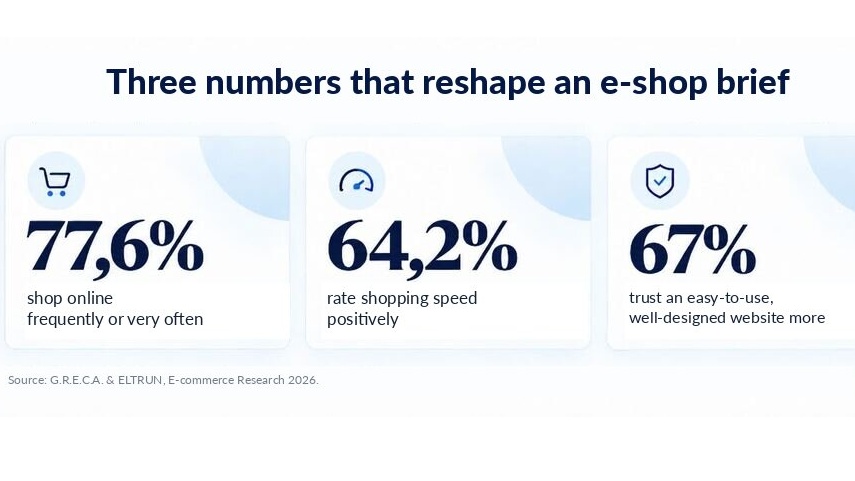
This also changes the brief for an e-commerce project. The conversation can no longer begin and end with aesthetics, the platform, or whether the store will “have a checkout.”
A modern e-commerce store must be designed around the entire user journey: from searching for and evaluating a product to payment, delivery or collection, and post-purchase support.
The key question is no longer “Do we have an e-commerce store?” It is “How easy do we make it for customers to choose us, trust us, and complete their purchase?”
1. UX Is Not Just About Aesthetics. It Is a Driver of Trust.
According to the survey, 67% of respondents say that an easy-to-use, well-designed website contributes to their trust in an online store. Prompt support before and after a purchase also scores 67%, positive reviews score 64%, and clear terms and conditions score 60%.
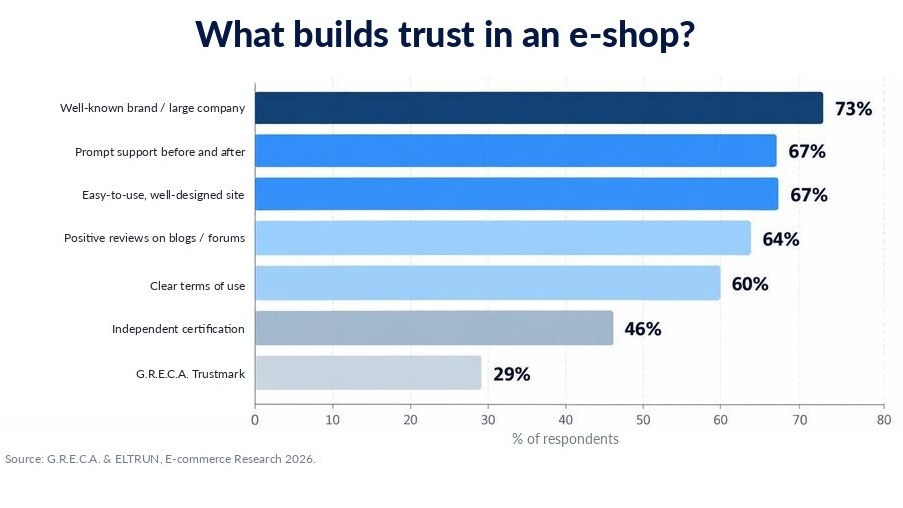
UX, therefore, is not decoration.
It is part of the mechanism through which users assess whether an online store is trustworthy. An environment that makes navigation difficult, hides critical information, or creates uncertainty about the next step is not simply less convenient. It introduces friction precisely when users need to make a decision.
In practice, this means an e-commerce store should have:
- Clear categorisation, intuitive navigation, and search and filtering tools that help users find the right product quickly.
- Product pages that answer key questions about features, availability, delivery, and returns without delay.
- Visible trust signals, including company information, transaction terms, customer reviews, and certifications where applicable.
- A mobile experience designed as a primary use case, rather than a “smaller version” of the desktop site.
2. Speed Is Not Just About Page Speed. It Is About How Quickly Customers Can Complete a Purchase.
A total of 64.2% of survey participants view “speed in shopping” as a benefit of online shopping. An important distinction is needed here: the survey does not measure loading times, Core Web Vitals, or conversion losses caused by slow pages. Therefore, it would be incorrect to use these findings as evidence that a specific page-load time increases or decreases sales.
What the survey does demonstrate is that consumers expect a fast purchasing process. For design and development, this expectation translates into fewer obstacles: quick product discovery, clear information, fewer unnecessary steps, predictable interface behaviour, and technical performance that does not interrupt the user journey.
The right way to think about “speed” in e-commerce is time to purchase: how easily users move from purchase intent to completing their transaction.
3. Checkout Should Adapt to How Customers Want to Pay.
Debit cards remain the dominant payment method, with 67.3% of respondents saying they usually use them. Apple Pay and Google Pay account for 34.4%, highlighting the growing importance of mobile-first payments.
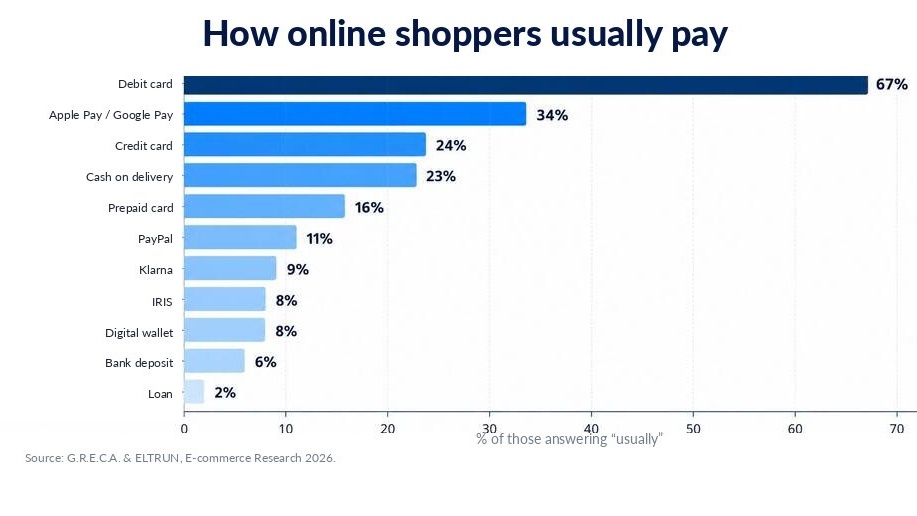
The survey does not measure checkout abandonment or compare guest checkout, the number of form fields, or one-page checkout experiences. However, it does point to a clear development requirement: users expect payment options, and checkout must present them without becoming more complicated.
- Core payment methods should be clearly displayed and presented without ambiguity.
- Mobile checkout must be designed for real-world use on mobile devices.
- Shipping costs, delivery times, and delivery methods must be clearly communicated before the final order confirmation.
- Payment integrations must work reliably and provide clear feedback when a transaction succeeds, fails, or remains pending.
It is also worth noting that 23% of respondents say shipping costs are “usually” high relative to the value of the product. Revealing shipping costs late in the process does not solve the problem. It simply shifts the frustration closer to the point of purchase completion.
4. The Shopping Experience Does Not End at “Pay.”
Lockers are now the most commonly used delivery or collection option among survey participants: 73.1% say they usually use them, compared with 52.5% who usually opt for home delivery. (pp. 20 and 28) This shift shows that delivery flexibility has become an integral part of the e-commerce experience.
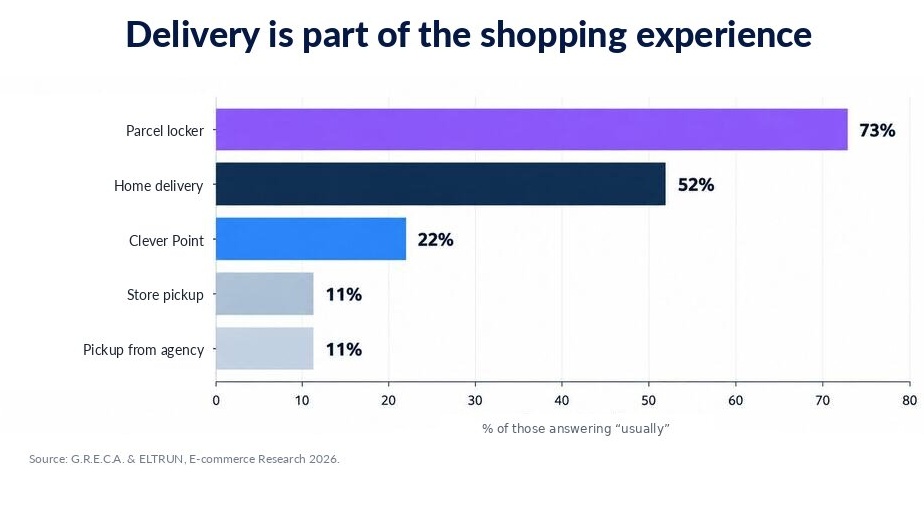
As a result, part of the UX responsibility extends beyond the front end to integrations and operational design. An e-commerce store must be able to display available delivery and collection options accurately, manage service areas and collection points, and maintain a seamless experience after checkout through order confirmations, tracking, notifications, and a clear returns process.
5. The E-commerce Store Is a Central Part of the Customer Journey — But Not the Only One.
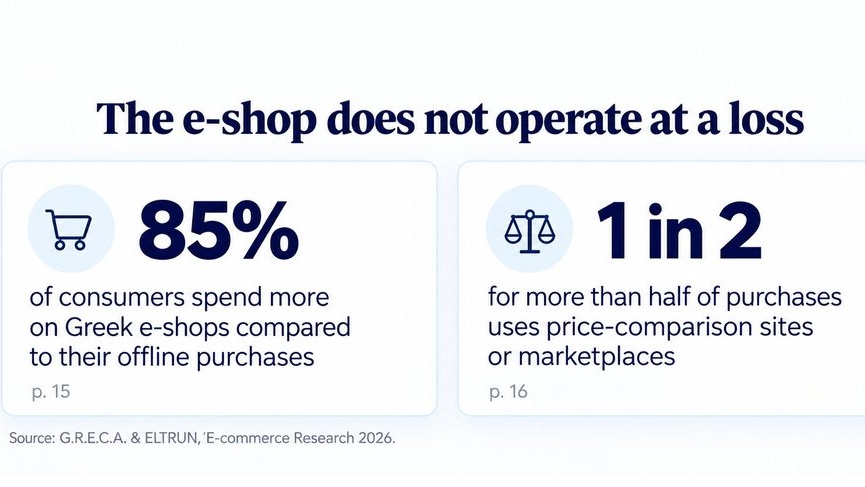
Some 85% of shoppers make more than half of their online purchases from Greek e-commerce stores. At the same time, one in two uses price-comparison websites or marketplaces for more than half of their purchases.
Before making an online purchase, consumers primarily seek information on websites featuring user reviews, company websites, and price-comparison platforms.
This means an e-commerce store should be treated as part of a wider ecosystem, rather than as a standalone digital storefront.
- Consistent product information across the website, product feeds, and marketplaces.
- An SEO architecture that makes categories and products easy to discover.
- Accurate structured product data and the appropriate technical infrastructure.
- Review management and trust signals as integral parts of the customer journey.
- Analytics that reveal where users come from and at which point purchases are lost.
What Should an E-commerce Project Brief Include in 2026?
If we translate the survey findings into practical requirements, the following questions should be answered before development begins.
1. Information Architecture: How will users find the right product, and what filters, categories, and search logic will they need?
2. Product Experience: What information do customers need to compare products and make decisions with confidence?
3. Trust: Where and how will reviews, terms and conditions, returns policies, company details, and certifications be presented?
4. Checkout: Which steps are genuinely necessary, and which payment methods must be supported?
5. Delivery & Fulfilment: How will lockers, couriers, collection points, delivery times, and shipping costs be integrated?;
6. SEO & Discoverability: How will categories and products remain visible in search results and across other channels?
7. Measurement: Which events and KPIs will help us identify friction points and understand where conversions are being lost?
An E-commerce Store Is Not a Digital Catalogue. It Is a Commercial System.
The key message of the 2026 E-commerce Survey is not simply that online shopping has become firmly established in consumers’ everyday lives. It is that online shoppers have clear expectations about how they want to buy: easily, quickly, transparently, with options and consistency.
That is why building a modern e-commerce store cannot be treated as a “design + development” project. It requires a combination of strategy, UX, technology, SEO, integrations, and measurement. The goal is not simply to make the website work. It is to make it work for the way customers shop today.
Planning a New E-commerce Store or a Redesign?
We are here to help you make the right decisions before development begins — from site structure and UX to checkout, payments, integrations, and measurement.
Let’s design an e-commerce store built around how customers actually search, choose, and buy.
The 2026 E-commerce Survey was conducted by the Greek E-Commerce Association (GR.EC.A.) and the ELTRUN E-Business Research Center at the Athens University of Economics and Business, using a sample of 600 Greek consumers who shop online.