Why Your Website Is Not Generating Leads (and How to Fix It)

You have invested in a professional website, the design is modern, and your corporate presence is clearly presented — and yet, the leads are either nonexistent or far fewer than expected.
If you are wondering why your online presence is not translating into new clients, this article is for you.
At White Space, we have seen dozens of cases where companies believed they were doing “everything right” — except for the essential parts.
Let’s look at the six most common obstacles that prevent a website from performing effectively… and most importantly, how to overcome them.
1. No Strategy — Only Aesthetics
Design matters — but it is only the beginning.
A visually appealing website without a strategic foundation is like a store without salespeople: it attracts attention, but it does not lead to conversions.
Example:
If your website explains who you are and what you do but does not clarify how you help the client or does not guide them toward the next step, then the site is not fulfilling its purpose.
What you can do:
- Review every page through a strategic lens: what purpose does it serve?
- Is there a clear path from interest → trust → action?
If not, start by defining a clear conversion path: who is your ideal visitor, and what should they do?
2. You Talk About Yourself — Not the User
This is perhaps the most common mistake in B2B and service-oriented businesses.
You fill the site with “We are…”, “Our team…”, “Our experience…” — but the user is not interested in you.
They are interested in themselves. What problem do you solve for them? How do you add value?
Example:
The sentence:
“We have 20 years of experience in the real estate sector with a high-value portfolio.”
has a completely different impact compared to:
“We help you find the ideal property based on your real needs and capabilities — without wasted time or unnecessary appointments.”
What you can do:
- Conduct a simple exercise: count how many “we” statements appear on your homepage versus how many “you” or “our clients” statements.
Balance your business description with clear, client-focused benefits.
3. Your Website Is Not Technically User-Friendly
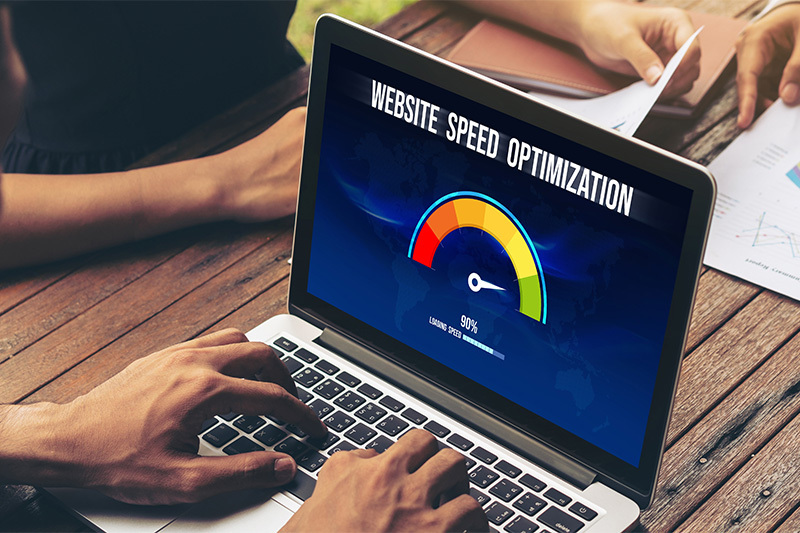
User experience (UX) is not only about aesthetics. It is about speed, navigation, and accessibility across all devices.
If your website loads slowly or displays poorly on mobile devices, users will leave immediately.
According to Google, every additional second of loading time increases bounce rate by 32%.
What you can do:
- Use tools such as Google PageSpeed Insights and GTmetrix.
- Optimize images, scripts, and CSS files.
- Test the user experience across various devices — not only desktop.
4. You Are Not Measuring Anything — or You Are Measuring the Wrong Things
Yes, you understood correctly: we are talking about your analytics.
Website performance is not a matter of “gut feeling.”
If you are not using measurement tools or tracking user behavior, you are essentially operating blindly.
Example:
Your website receives good traffic but generates no leads — and you have no idea why because you lack heatmaps or event tracking.
What you can do:
- Install Google Analytics 4, Google Tag Manager, and Hotjar.
- Define conversion goals — not just page views.
- Identify what works and what does not (e.g., scroll depth, clicks).
5. You Do Not Inspire Trust
A visitor may only see your site once. If you do not convince them in that moment, the opportunity is lost.
And to persuade them, you need proof.
Example:
A website with no testimonials, no case studies, no client logos, and no awards gives the visitor no reason to trust you — no matter how well-written the copy is.
What you can do:
- Add social proof to all key touchpoints of the site.
- Showcase projects, results, or even small success stories.
- Remember: the design of testimonials matters — not all formats are equally effective.
6. You Do Not Tell the Visitor What to Do
Many websites assume that users will know where to go. They will not.
If you do not guide them with clear and compelling Calls to Action (CTAs), they will simply… leave.
Example:
A landing page with a well-written service description but no “Request a Demo” or “Book a Call” button is relying on users to search for a contact form in the footer.
What you can do:
- Include one primary CTA per page — prominent and functional.
- Do not hesitate to repeat it (as long as it does not become excessive).
- Run A/B tests with CTA phrasing such as:
“Get Started Now” vs. “Book a Free 15-Minute Session.”
Conclusion
If your website is not generating leads, then you likely have a presentation website — not a strategic one. And that is critical.
Your website is the first point of contact a potential client has with your business. If it is not working in your favor, it is working against you.
At White Space, we design websites with growth in mind — not just presence.
If you want to transform your digital identity into a sales-driven asset, send us a message. We are here to make it happen together.