Websites for Construction and Real Estate Companies: What They Need to Do Beyond Looking Good
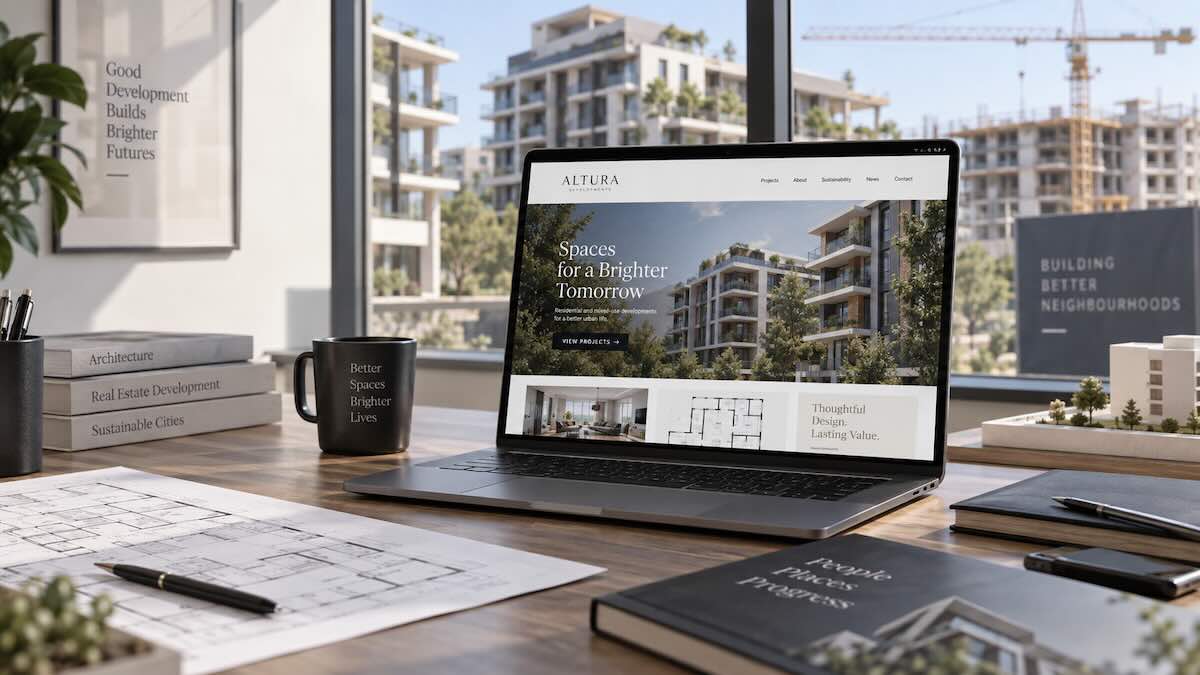
For a construction company or a real estate business, the website is often one of the first points of contact with a potential client, buyer or investor.
And while aesthetics clearly matter in an industry where image plays a decisive role, a visually impressive website is not enough on its own.
It needs to clearly explain who the company is, what differentiates its projects or services, what value it provides and why someone should choose it. At the same time, it needs to present projects effectively, build trust and guide visitors towards the next step.
Because in real estate, a website is not simply a digital showcase. It is a tool for positioning, branding, marketing and sales.
That is where the real difference lies between a website that simply looks good and one that actively contributes to business growth.
1. Clearly communicate the positioning of the company or project
Real estate websites often place strong emphasis on visual impact: impressive renders, architectural photography, videos and animations designed to showcase the project.
But a strong visual presence is not enough. Before design comes a more fundamental question:
Why should someone choose this company or this particular project?
Contemporary architecture, a strong location or high construction quality do not, on their own, constitute positioning — especially when similar promises are being made by almost every competitor.
The website should clearly communicate:
- the company’s philosophy and identity,
- the audience it is addressing,
- what differentiates its approach or projects,
- the value it offers to buyers or investors,
- and the position it wants to occupy in the market.
If these elements are not clear, even an exceptionally designed website may ultimately present a company that looks very similar to many others.
2. Turn features into real value
In real estate, simply listing features is not enough.
Visitors do not only want to know how many square metres an apartment has, what materials are being used or how far a development is from the city centre.
They want to understand what all of this means for them.
A strong energy rating may mean lower running costs.
The location may mean a better everyday lifestyle or stronger investment potential.
The architecture may translate into more natural light or more efficient use of space.
Shared amenities may significantly influence the way residents live.
The right website therefore does more than provide information.
It turns information into benefits and benefits into perceived value.
3. Guide visitors through a clear journeyομή

Not everyone visits a real estate website with the same intent.
One visitor may already know the project and be looking for a specific apartment. Another may only be at the beginning of their research. An investor may be more interested in the location and its future prospects, while a homebuyer may place greater importance on quality of life.
The website needs to support these different needs and naturally guide users from first contact towards a decision:
Discovery → Understanding → Interest → Evaluation → Enquiry
This requires the right information architecture, clear navigation, proper content hierarchy and calls to action that appear at the moments when they are genuinely relevant.
4. Present projects in a way that supports decision-making
Visuals play a critical role in real estate, particularly when a project is still under construction.
But their purpose should not simply be to impress.
Renders, photography, videos, floor plans, maps, availability information and interactive elements should help visitors understand the property more clearly.
How are the spaces organised?
What is the relationship between indoor and outdoor areas?
Where is the project located in relation to important points in the surrounding area?
What types of residences are available?
What differentiates one option from another?
Good presentation does more than add aesthetic value.
It reduces uncertainty for the prospective buyer.
5. Build trust
Buying or investing in property is a high-value decision. Visitors are therefore not only evaluating the project.
They are also evaluating who is behind it.
The company’s experience, previous projects, partners, architects, contractors, certifications, project progress and factual information about the company’s track record can all act as important credibility signals.
A strong portfolio, for example, should not function simply as a gallery.
It should demonstrate experience, consistency and the ability to deliver.
In real estate, trust is not an additional element of the website.
It is part of the sales process.
6. Turn interest into qualified leads
The website should not end with presentation.
There needs to be a clear next step.
Depending on the company or project, visitors may want to:
- request more information,
- download a brochure,
- express interest in a specific property,
- request available prices or floor plans,
- schedule a meeting,
- contact the sales team.
The objective, however, is not simply to have forms on the website.
The objective is to create the right conversion points at the right stages of the user journey.
A simple “Contact Us” button at the bottom of a page does not, by itself, constitute a sales funnel.
7. Support advertising campaigns
Google Ads, Meta Ads, remarketing and other paid activities can bring significant traffic to a real estate website.
But if the experience after the click is not right, part of that investment is wasted.
The landing page should continue the campaign message seamlessly and take users directly to the content they expect to find.
If an ad promotes a specific development or property type, users should not land on a generic corporate homepage and be expected to search for the information themselves.
The website and performance marketing need to work as one integrated system.
8. Be designed for organic search as well

A real estate website should not depend exclusively on paid traffic for visibility.
Users search for information about locations, properties, new developments, homes for sale, investment opportunities, developers and specific property types.
For a website to appear in these searches, it needs:
- a strong SEO structure,
- clear headings and URLs,
- content aligned with search intent,
- effective internal linking,
- landing pages for important topics,
- and valuable, useful content around the market and the projects.
At the same time, as search behaviour evolves, content needs to be structured so that it can be understood not only by traditional search engines but also by AI-powered search environments.
This is why SEO should now be considered together with GEO and AEO, rather than as an isolated technical activity.
9. Perform flawlessly on mobile
One of the most common issues with real estate websites is that the desire to create a highly impressive visual experience often results in excessively heavy websites.
Large videos, high-resolution renders, sliders and animations can significantly affect speed and usability — particularly on mobile devices.
This creates a clear contradiction:
A company may be communicating quality, contemporary design and attention to detail while its website takes several seconds to load or is difficult to use on a mobile device.
Speed, technical performance and mobile UX are not in opposition to aesthetics.
They are part of the overall quality of the experience.
10. Measure what actually works
Without data, a website remains, to a large extent, based on assumptions.
How many users visit a specific project?
Which property types attract the most interest?
Which channels generate the leads?
How many users begin a form and how many complete it?
Which campaigns generate higher-quality enquiries?
A website should be designed from the outset with proper analytics and conversion tracking in place.
And where there is a structured sales process, connecting digital leads with the CRM can provide even more meaningful insights.
Because the real question is not simply how many leads were generated.
It is which of those leads developed into genuine commercial opportunities.
A strong real estate website is part of a larger system
A website does not operate in isolation.
It is connected to brand positioning, corporate identity, projects, content, advertising, SEO, lead generation and ultimately the sales process.
That is why its design should not begin with the question:
“How do we want it to look?”
But with more meaningful questions:
Who are we speaking to? What do we want them to understand? What needs to convince them? And what action do we want them to take next?
Aesthetics remain important — especially in real estate.
But they are only one part of the equation.
An effective website is one that brings together strategy, positioning, branding, UX, technology, search and lead generation into one cohesive experience.
Want your real estate marketing to work as one integrated system?
At White Space, we approach real estate marketing holistically: from strategy and positioning to branding, website development, lead generation, performance marketing and SEO.
The objective is not simply to create an attractive digital presence, but to build a system that actively supports the commercial growth of the company or project.