
Search is changing. But not in the simplistic way many people describe it.
SEO is not dead. Google is not irrelevant. AI is not replacing every search journey overnight. At the same time, brands that treat search exactly as they did five years ago are already falling behind.
The real shift is this: people no longer discover businesses only through a list of blue links. They search, compare, ask, refine, and expect answers across multiple environments — Google Search, AI Overviews, ChatGPT, Perplexity, voice assistants, featured snippets, review platforms, social search and brand websites.
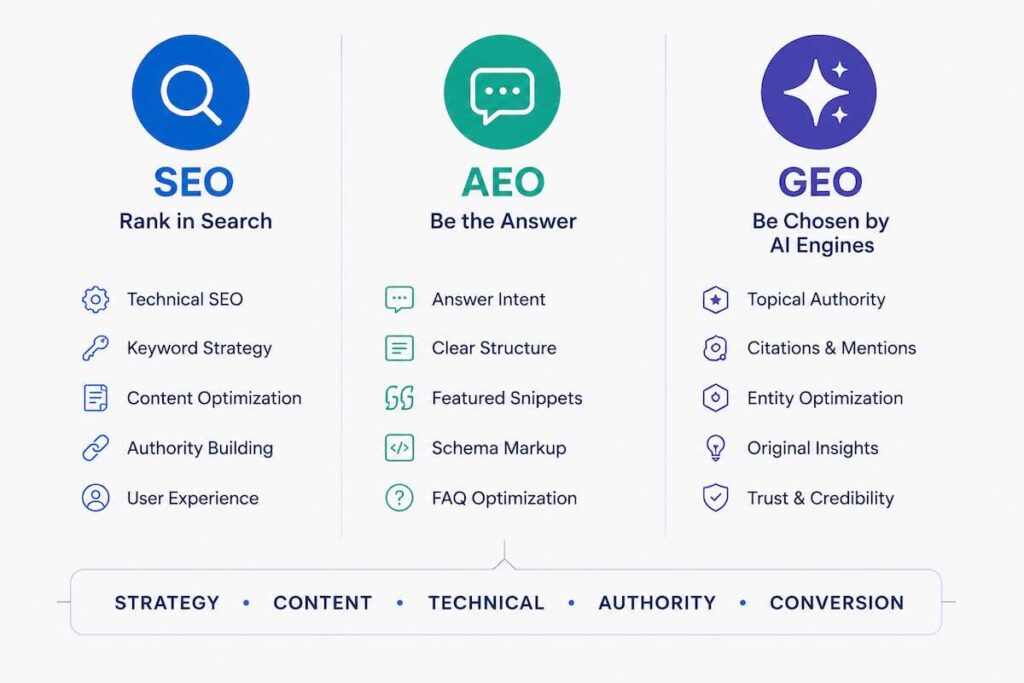
That is why terms like SEO, GEO and AEO are everywhere.
But the important question is not which acronym sounds more advanced.
The important question is: what actually improves visibility, trust and business results?
First, what do SEO, GEO and AEO mean?
SEO: Search Engine Optimization
SEO is the foundation. It is the process of helping search engines understand, crawl, index and rank your website, while helping users find the right information and decide whether your business is relevant to them. Google’s own SEO Starter Guide describes SEO as helping search engines understand your content and helping users find your site through search.
In practical terms, SEO includes:
- Technical health
- Site structure
- Page speed
- Indexability
- Keyword strategy
- Search intent
- Content quality
- Internal linking
- Authority signals
- Local visibility
- Conversion-focused landing pages
SEO still matters because most AI-driven discovery systems depend, directly or indirectly, on well-structured, accessible and trustworthy web content.
No crawlable content. No visibility.
No clear positioning. No relevance.
No authority. No reason to be selected.
AEO: Answer Engine Optimization

AEO focuses on making your content easy to understand, extract and present as a direct answer.
This matters because users increasingly ask complete questions instead of typing fragmented keywords. They want fast, clear answers: “What is the best marketing strategy for a real estate project?”, “How much should a business invest in SEO?”, “What is the difference between branding and performance marketing?”
AEO is about structuring your content so that search engines and AI systems can identify:
- The question being answered
- The short answer
- The deeper explanation
- The context
- The source of expertise
- The next useful step
This does not mean writing shallow FAQ content. That is a weak tactic.
Good AEO means answering real questions with clarity, structure and substance.
GEO: Generative Engine Optimization
GEO stands for Generative Engine Optimization. It refers to optimizing content for visibility inside AI-generated responses from generative search systems.
Academic research on GEO defines it as a framework for improving how website content appears inside generative engine responses, where visibility is no longer just about ranking position but also about citation, attribution, relevance and influence within the generated answer.
This is important because AI search experiences do not always behave like traditional search results.
Traditional SEO asks:
Can we rank higher?
GEO asks:
Can our brand, content or expertise be selected, cited or used when AI generates an answer?
That is a different game. But it is not a disconnected game.
GEO still needs strong content, authority, clarity, technical accessibility and brand credibility.
So, is SEO being replaced?
No. The idea that SEO is being replaced is lazy thinking.
What is happening is more precise: SEO is expanding.
Google is already integrating AI into Search through features such as AI Overviews, which summarize complex topics and provide links for further exploration. Google also announced in May 2026 a broader shift toward AI-powered Search experiences, describing it as one of the biggest changes to Search in more than 25 years.
That means businesses need to think beyond rankings alone. But abandoning SEO would be a mistake.
Because the same fundamentals that help a page perform in traditional search often support visibility in AI-driven environments:
- Clear information architecture
- Strong topical relevance
- Original content
- Structured data
- Entity consistency
- Authority signals
- Fast, accessible pages
- Trustworthy brand presence
The brands that will win are not the ones chasing every acronym.
They are the ones building content ecosystems that are useful, technically clean, strategically positioned and easy for both people and machines to understand.
What actually matters?
1. Clear positioning
If your business does not clearly explain what it does, who it helps and why it is different, no SEO tactic will save it.
Search engines can index your content. AI systems can summarize it. Users can land on it.
But if the message is generic, the business will still feel interchangeable.
This is where many brands fail. They publish articles, service pages and landing pages without a clear strategic core.
Before asking “how do we rank?”, ask:
- What do we want to be known for?
- What problems do we solve better than others?
- Which audience are we trying to attract?
- What language does that audience actually use?
- What proof do we have?
Without positioning, SEO becomes traffic without direction.
2. Search intent, not just keywords
Keywords still matter. But keywords alone are not strategy.
A keyword tells you what someone typed. Search intent tells you what they need.
For example, someone searching “branding agency” may want:
- A definition
- A list of agencies
- A comparison
- A proposal
- A case study
- A pricing indication
- A strategic partner
If your content does not match the intent, it will underperform even if it includes the right keyword.
For SEO, intent helps you rank.
For AEO, intent helps you answer.
For GEO, intent helps AI systems understand when your content is relevant enough to be used.
3. Content depth and originality
Thin content is becoming more useless.
Not because AI punishes it directly, but because it gives no reason to be selected, cited, remembered or trusted.
A basic article that repeats what already exists has limited value. A stronger article adds:
- A clear point of view
- Practical experience
- Examples
- Data
- case studies
- comparisons
- frameworks
- original explanations
- specific recommendations
This matters especially for GEO. Research on generative engine visibility found that tactics such as adding citations, relevant quotations and statistics can improve visibility in generative responses.
The conclusion is simple: generic content is weak content.
AI can reproduce generic content instantly.
Your advantage is not volume. It is judgment.
4. Technical structure
Technical SEO is not glamorous, but it is non-negotiable.
If your website is slow, confusing, badly structured or difficult to crawl, your content has a visibility problem before the user even sees it.
Technical foundations include:
- Clean URL structure
- Proper headings
- XML sitemaps
- Internal linking
- Canonicals
- Mobile performance
- Page speed
- Schema markup
- Indexation control
- Clean code
- Accessible design
Structured data also matters because it helps search engines understand what a page is about. Google describes structured data as a standardized format for providing information about a page and classifying its content. Schema.org also explains that structured markup helps search engines and other applications better understand web content.
Structured data will not fix weak content.
But strong content without structure leaves visibility on the table.
5. Entity consistency
Modern search is not only about pages. It is about entities.
A brand is an entity. A person is an entity. A service is an entity. A location is an entity. A project is an entity.
If your business appears differently across your website, Google Business Profile, LinkedIn, directories, PR mentions, case studies and social profiles, search systems receive mixed signals.
For stronger SEO, AEO and GEO, your brand needs consistency across:
- Name
- Services
- Location
- Industry
- Authors
- Case studies
- Social profiles
- Business descriptions
- Structured data
- External mentions
This is especially important for agencies, professional services, hotels, real estate projects, healthcare providers, educational institutions and B2B companies.
If the web cannot clearly understand who you are, what you do and why you matter, AI will not magically understand it either.
6. Authority and proof
Visibility without credibility is fragile.
A business cannot rely only on optimized copy. It needs proof.
Proof can include:
- Case studies
- Client results
- Reviews
- Awards
- Certifications
- Media mentions
- Expert authorship
- Strong portfolio pages
- Before/after examples
- Measurable outcomes
- Long-term client relationships
This is where brand and SEO connect.
A strong brand gives search content more weight because it creates recognition, trust and differentiation.
A strong SEO strategy gives the brand more discoverability.
One without the other is weaker.
7. Conversion architecture
Ranking is not the final goal.
Being cited by AI is not the final goal.
Getting traffic is not the final goal.
The final goal is business movement: leads, sales, bookings, calls, requests, applications, donations or qualified conversations.
That means every SEO, AEO or GEO strategy must connect to conversion architecture.
A page should make it clear:
- Who this is for
- What problem it solves
- Why the brand is credible
- What the user should do next
- What happens after they take action
Too many businesses invest in content that attracts visitors but does not move them.
That is not a visibility strategy.
That is noise.
The wrong way to approach SEO, GEO and AEO
The wrong approach is to treat them as three separate services with three separate checklists.
That creates fragmented work:
- SEO team optimizes keywords
- Content team writes articles
- Developer adds schema
- Performance team runs ads
- Brand team works separately
- Nobody owns the full journey
This is inefficient.
The user does not experience your business in departments.
Search systems do not evaluate your brand in isolation.
AI does not understand your authority from one page alone.
Everything connects.
The right way: build a visibility system
The right approach is to build a complete visibility system.
That means connecting:
- Brand strategy
- SEO strategy
- Content architecture
- Technical implementation
- Structured data
- Website experience
- Digital PR
- Performance marketing
- Analytics
- Conversion optimization
SEO helps people find you.
AEO helps your expertise become answer-ready.
GEO helps your brand become more visible inside generative discovery environments.
But all three depend on the same strategic foundation: clarity, relevance, credibility and structure.
Final answer: what actually matters?
Not the acronym.
Not the trend.
Not the promise that “AI changed everything.”
What matters is whether your brand is clear, credible, technically accessible and useful enough to be selected.
Selected by search engines.
Selected by AI systems.
Selected by users.
Selected by the market.
SEO, GEO and AEO are not enemies.
They are different layers of modern visibility.
The businesses that will gain the advantage are not the ones producing more content.
They are the ones producing better systems.
Systems that connect strategy, creativity, data and technology.
That is where visibility becomes growth.
Turn visibility into measurable growth
Modern search is no longer limited to rankings. Your brand needs to be discoverable, understandable and credible across Google, AI search, answer engines and every digital touchpoint that influences a user’s decision.
At White Space, we help businesses build digital visibility systems that connect SEO, content strategy, website structure and performance marketing into one clear growth framework.
From search visibility and technical SEO to Google Ads, landing pages, conversion tracking and performance campaigns, we design strategies that do not stop at traffic. They are built to bring qualified users closer to action.
If your business wants to be found, understood and chosen, White Space can help you turn search visibility into measurable performance. Explore Performance Marketing Services